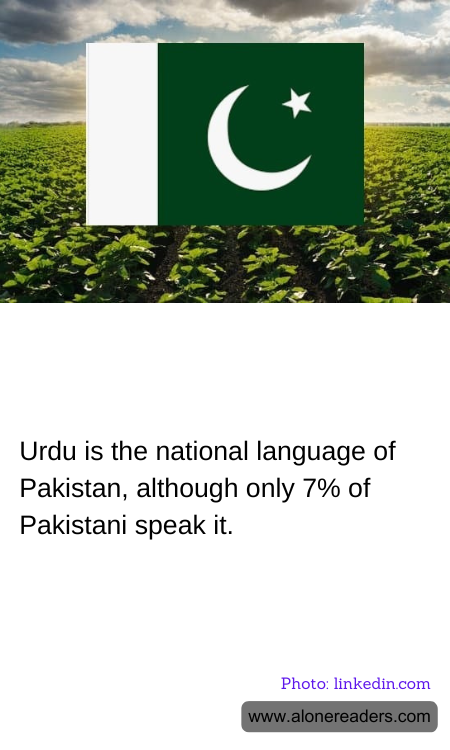
Urdu, the national language of Pakistan, holds a unique position in the country's cultural and linguistic landscape. Despite being the official language, only about 7% of Pakistan's population speaks Urdu as their mother tongue. This statistic might seem surprising at first, but it reflects the rich tapestry of languages and dialects that coexist within the nation.
The decision to adopt Urdu as the national language dates back to the formation of Pakistan in 1947. Urdu was chosen for its historical significance and its role as a lingua franca that could bridge the diverse ethnic and linguistic groups across the newly formed country. It was seen as a unifying force, capable of fostering a sense of national identity among people who spoke a multitude of regional languages such as Punjabi, Sindhi, Pashto, Balochi, and others.
Urdu's roots are deeply intertwined with the cultural and literary heritage of South Asia. It evolved during the Mughal era, drawing from Persian, Arabic, Turkish, and local dialects, and became a medium for poetry, literature, and scholarly discourse. The language's rich literary tradition continues to thrive, with Urdu poetry and prose being celebrated not only in Pakistan but also in India and among the global South Asian diaspora.
In Pakistan, Urdu serves as the medium of instruction in many schools and is the language of government and media. It plays a crucial role in official communication and is often used in national and international forums. Despite this, the everyday linguistic reality for most Pakistanis involves a blend of Urdu and their native languages. This multilingual environment enriches the cultural fabric of the country, allowing for a dynamic exchange of ideas and traditions.
The prominence of Urdu in education and media has contributed to its widespread understanding and use as a second language. Many Pakistanis, regardless of their mother tongue, are fluent in Urdu, which facilitates communication across different regions and communities. This bilingual or multilingual proficiency is a testament to the adaptability and resilience of the Pakistani people.
While Urdu's status as the national language is sometimes debated, it remains a symbol of unity and identity for Pakistan. It embodies the country's historical journey and its aspirations for cohesion amidst diversity. As Pakistan continues to evolve, the role of Urdu will likely adapt, reflecting the changing dynamics of society while maintaining its place as a cornerstone of national identity.
In conclusion, Urdu's significance in Pakistan extends beyond mere numbers. It is a language that connects people, transcending regional and ethnic boundaries. As Pakistan navigates its future, the interplay between Urdu and the myriad of other languages spoken within its borders will continue to shape the nation's cultural and linguistic identity.
