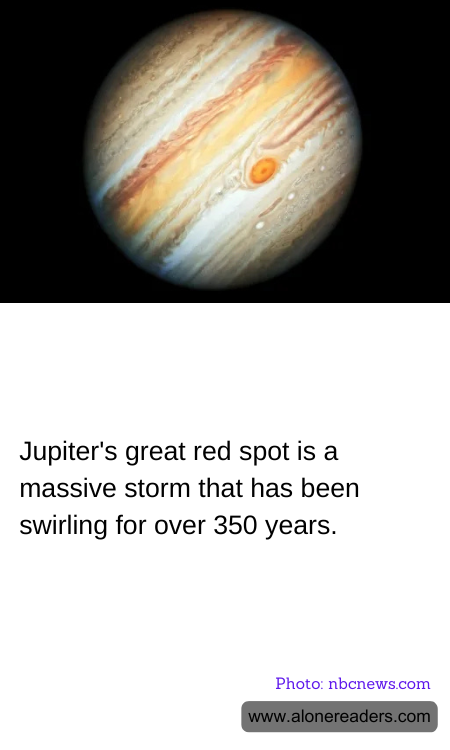
Jupiter, the largest planet in our solar system, is a gas giant known for its striking features and immense size. Among its most captivating characteristics is the Great Red Spot, a massive storm that has been swirling in the planet's atmosphere for over 350 years. This colossal storm is not only a testament to the dynamic nature of Jupiter's atmosphere but also a source of intrigue and fascination for astronomers and space enthusiasts alike.
The Great Red Spot is an anticyclonic storm, meaning it rotates in the opposite direction of cyclones on Earth. It is located in Jupiter's southern hemisphere and is easily recognizable due to its reddish hue and oval shape. The storm is so large that it could easily engulf Earth, with its diameter measuring approximately 1.3 times that of our planet. Despite its size, the exact cause of the storm's reddish color remains a mystery. Scientists speculate that the hue may be due to the presence of complex organic molecules, red phosphorus, or other chemical compounds reacting with ultraviolet light from the Sun.
The longevity of the Great Red Spot is another aspect that captivates scientists. While storms on Earth typically last for a few days or weeks, this Jovian storm has persisted for centuries. Its persistence is attributed to Jupiter's lack of a solid surface, which allows storms to sustain themselves without the frictional forces that would typically dissipate them on a terrestrial planet. Additionally, the planet's rapid rotation and the absence of significant landmasses contribute to the storm's longevity by maintaining the energy needed to keep it swirling.
Over the years, the Great Red Spot has been observed to change in size and color. Historical records suggest that it was once much larger than it is today, and recent observations indicate that it has been gradually shrinking. Despite this reduction in size, the storm remains a powerful and enduring feature of Jupiter's atmosphere. The changes in its appearance and dimensions continue to be a subject of study, as scientists strive to understand the underlying mechanisms driving these transformations.
The Great Red Spot serves as a natural laboratory for studying atmospheric dynamics and weather patterns on a planetary scale. By observing this storm, scientists gain valuable insights into the behavior of Jupiter's atmosphere and the forces at play in its turbulent environment. These observations not only enhance our understanding of Jupiter but also provide a broader perspective on atmospheric phenomena that may occur on other planets, both within and beyond our solar system.
In conclusion, Jupiter's Great Red Spot is a remarkable and enduring feature that has captivated the imagination of scientists and the public for centuries. Its immense size, striking color, and longevity make it a unique phenomenon in our solar system. As technology advances and our ability to observe distant worlds improves, the Great Red Spot will undoubtedly continue to be a focal point of research, offering new insights into the mysteries of our universe.
