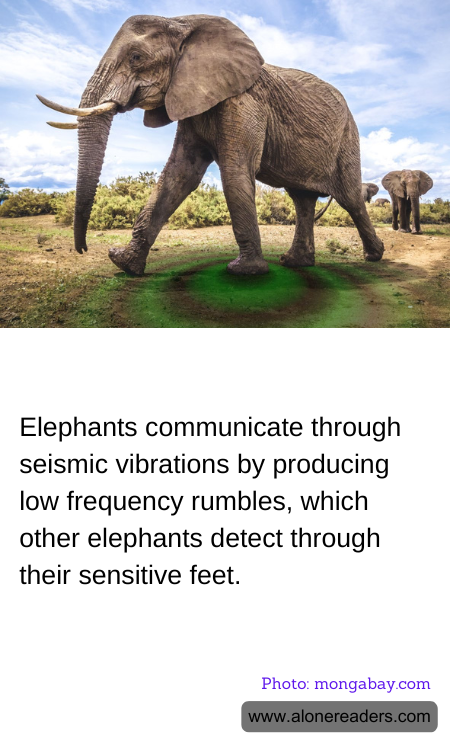
Elephants, the gentle giants of the animal kingdom, have long fascinated scientists and nature enthusiasts alike with their complex social structures and behaviors. One of the most intriguing aspects of elephant communication is their ability to send and receive messages through seismic vibrations. This remarkable form of communication involves producing low-frequency rumbles that travel through the ground, allowing elephants to communicate over long distances.
These low-frequency sounds, often referred to as infrasound, are below the range of human hearing but are perfectly suited for the elephants' needs. When an elephant produces a rumble, the sound waves travel through the earth, creating vibrations that can be detected by other elephants. This method of communication is particularly useful in dense forests or over vast savannas where visual contact may be limited.
Elephants have evolved to be highly sensitive to these vibrations, thanks in part to their unique anatomy. Their feet are equipped with a dense cushion of fatty tissue that acts as a natural sensor, allowing them to detect even the faintest of vibrations. This sensitivity is further enhanced by the structure of their feet, which are designed to maximize contact with the ground. By placing their feet carefully and remaining still, elephants can pick up on the subtle seismic signals sent by their companions.
This form of communication is not only fascinating but also vital for the survival of elephant herds. It allows them to convey important information about potential threats, such as predators or human activities, as well as to coordinate movements and maintain social bonds. For instance, a matriarch may use seismic signals to lead her herd to a new water source or to warn them of danger. Similarly, elephants can use these vibrations to locate each other when separated, ensuring that family groups remain intact.
The study of seismic communication in elephants has opened up new avenues for understanding these majestic creatures and their interactions with the environment. Researchers have used advanced technology to record and analyze these vibrations, gaining insights into the elephants' social dynamics and their responses to external stimuli. This knowledge not only enriches our understanding of elephant behavior but also informs conservation efforts, helping to protect these endangered animals and their habitats.
In conclusion, the ability of elephants to communicate through seismic vibrations is a testament to their intelligence and adaptability. It highlights the complex and often hidden ways in which animals interact with their environment and each other. As we continue to study and appreciate these magnificent creatures, it becomes increasingly clear that there is much more to learn about the natural world and the incredible ways in which its inhabitants communicate.
