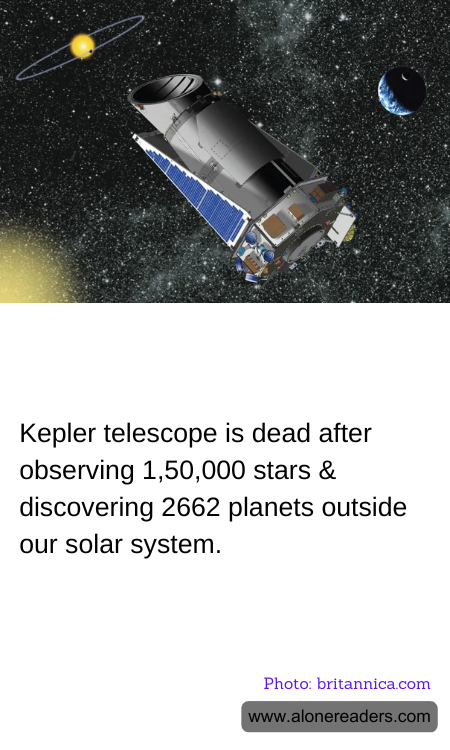
The Kepler Space Telescope, a pioneering instrument in the field of astronomy, has concluded its mission after nearly a decade of groundbreaking discoveries. Launched by NASA in 2009, Kepler was tasked with a singular, ambitious goal: to find Earth-like planets orbiting other stars. Over its operational life, Kepler observed over 150,000 stars and discovered 2,662 exoplanets, fundamentally altering our understanding of the universe and our place within it.
Kepler's mission was revolutionary in its approach. It utilized the transit method, which involves detecting the slight dimming of a star as a planet passes in front of it. This method allowed Kepler to identify planets that are similar in size to Earth and located in the habitable zones of their stars, where conditions might be right for liquid water—and potentially life—to exist. The telescope's discoveries have expanded the known diversity of planets, revealing a vast array of worlds, from gas giants larger than Jupiter to small, rocky planets like Earth.
One of Kepler's most significant contributions is the realization that planets are common in the galaxy. Before Kepler, the existence of planets outside our solar system was largely speculative. Now, thanks to its observations, we know that there are likely billions of planets in our galaxy alone. This has profound implications for the search for extraterrestrial life and the study of planetary systems.
Kepler's data has also provided insights into the formation and evolution of planetary systems. By studying the variety of exoplanets and their orbits, scientists have gained a better understanding of how planets form and migrate over time. This information is crucial for developing models of our own solar system's history and for predicting the characteristics of planets around other stars.
Despite its official retirement, Kepler's legacy continues. The vast amount of data it collected is still being analyzed, promising further discoveries for years to come. Its success has paved the way for future missions, such as the Transiting Exoplanet Survey Satellite (TESS) and the James Webb Space Telescope, which will build on Kepler's findings and continue the search for habitable worlds.
The end of Kepler's mission marks the conclusion of a remarkable chapter in space exploration. Its achievements have not only expanded our knowledge of the cosmos but have also inspired a new generation of scientists and stargazers. As we look to the future, Kepler's discoveries remind us of the vastness of the universe and the endless possibilities that lie beyond our solar system.
