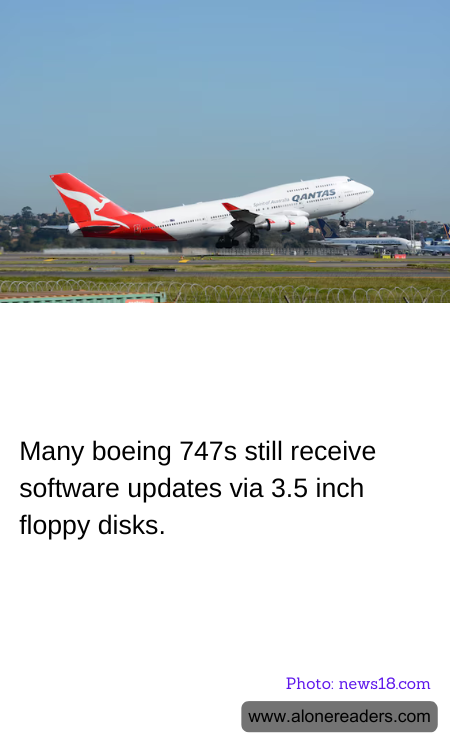
In an era where technology evolves at a breakneck pace, it might come as a surprise to many that some of the world's most iconic aircraft, the Boeing 747s, still rely on a technology that most people consider obsolete: the 3.5-inch floppy disk. These disks, once a staple of personal computing in the late 20th century, continue to play a crucial role in the maintenance and operation of these aviation giants.
The Boeing 747, often referred to as the "Queen of the Skies," has been a cornerstone of long-haul air travel since its introduction in the late 1960s. Despite the aircraft's age, many 747s remain in service today, thanks to their robust design and the continuous updates they receive. However, the method of delivering these updates is what captures the imagination of both aviation enthusiasts and tech aficionados alike.
Each month, engineers update the software that controls various systems on the 747s. These updates are delivered via 3.5-inch floppy disks, a medium that has largely disappeared from everyday use. The disks are used to load critical data into the aircraft's avionics systems, which manage everything from navigation to in-flight entertainment. This process is a testament to the longevity and reliability of the technology, even if it seems antiquated by modern standards.
The continued use of floppy disks in such a high-tech environment raises questions about why newer technologies have not replaced them. The answer lies in the aviation industry's emphasis on safety and reliability. Aircraft systems are subject to rigorous testing and certification processes, which can take years to complete. Introducing new technology into these systems requires extensive validation to ensure it meets the stringent safety standards. As a result, airlines and manufacturers often prefer to stick with proven technologies that have a long track record of reliability.
Moreover, the cost of retrofitting older aircraft with modern technology can be prohibitive. Many airlines operate on thin margins and must carefully weigh the benefits of upgrading against the costs involved. In this context, the use of floppy disks represents a practical solution that balances safety, reliability, and cost-effectiveness.
While the sight of a technician loading a floppy disk into a state-of-the-art aircraft might seem anachronistic, it highlights an important aspect of the aviation industry: the careful balance between innovation and tradition. As long as these disks continue to serve their purpose effectively, they will remain a part of the aviation landscape, a reminder of the enduring legacy of both the Boeing 747 and the humble floppy disk.
In a world where technology is often synonymous with the latest and greatest, the continued use of floppy disks in Boeing 747s serves as a fascinating example of how older technologies can coexist with modern advancements. It is a testament to the idea that sometimes, the simplest solutions are the most effective, even in the most complex of environments.
