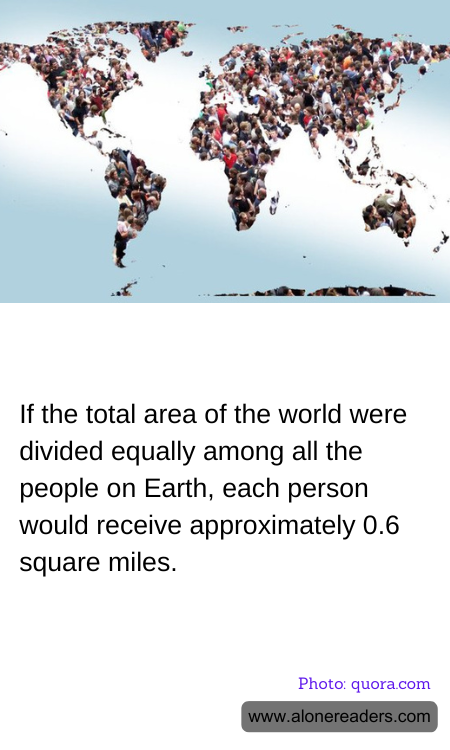
Imagine a world where every individual is granted an equal share of the Earth's land. With the planet's total land area being approximately 57.5 million square miles and a global population nearing 8 billion, each person would receive about 0.6 square miles. This hypothetical scenario offers an intriguing perspective on the distribution of resources and the vastness of our planet.
To put 0.6 square miles into context, it equates to roughly 384 acres. This is a substantial amount of land, considering that an average American football field, including the end zones, is about 1.32 acres. Thus, each person would have the equivalent of nearly 291 football fields to call their own. This thought experiment highlights the abundance of space available on Earth, yet it also underscores the complexities involved in resource distribution and management.
While the idea of equal land distribution is fascinating, it is essential to recognize the practical challenges it presents. Not all land is created equal; some areas are rich in resources, fertile for agriculture, or strategically located, while others may be arid, mountainous, or otherwise inhospitable. The diversity of land types means that an equal division would not necessarily result in equitable living conditions or opportunities for all. Additionally, the infrastructure, climate, and accessibility of each parcel would significantly impact its value and usability.
Furthermore, this scenario does not account for the existing social, economic, and political structures that govern land ownership and use. Land is often tied to cultural heritage, national identity, and economic systems, making a simple redistribution impractical. The complexities of land ownership are deeply rooted in history and vary widely across different regions and societies.
Despite these challenges, the concept of equal land distribution encourages us to reflect on the broader issues of inequality and resource allocation. It prompts us to consider how we can better manage the Earth's resources to ensure a more equitable and sustainable future for all. As the global population continues to grow, finding innovative solutions to balance resource distribution with environmental conservation becomes increasingly critical.
In conclusion, while the notion of dividing the Earth's land equally among its inhabitants is an intriguing exercise in imagination, it serves as a reminder of the importance of responsible stewardship and equitable resource management. By fostering a deeper understanding of these issues, we can work towards a future where everyone has the opportunity to thrive, regardless of the land they occupy.
