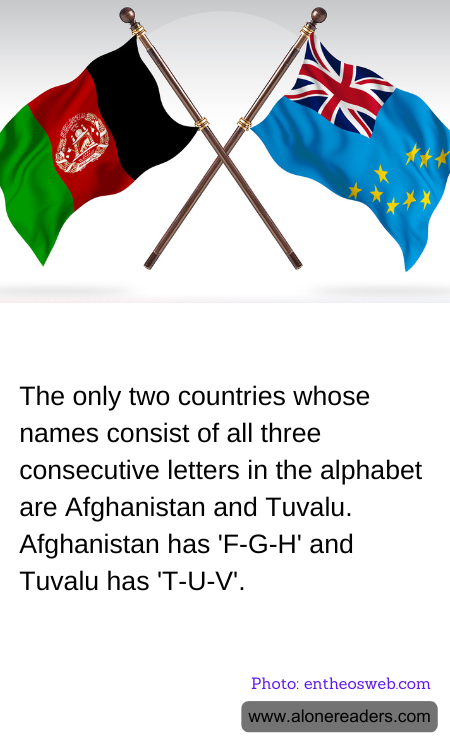
In the vast tapestry of global geography, countries are often recognized for their unique cultural, historical, and geographical attributes. However, an intriguing linguistic curiosity also sets some nations apart. Among the nearly 200 countries worldwide, only Afghanistan and Tuvalu boast names that contain three consecutive letters of the English alphabet. Afghanistan features the sequence 'F-G-H,' while Tuvalu includes 'T-U-V.' This peculiarity offers a delightful intersection of language and geography, sparking interest among trivia enthusiasts and linguists alike.
Afghanistan, a country nestled in the heart of South Asia, is renowned for its rich history and diverse cultural heritage. The sequence 'F-G-H' in its name is a subtle nod to the country's layered past, where various empires and civilizations have left their mark. Afghanistan's landscape is as diverse as its history, ranging from rugged mountains to fertile valleys. This landlocked nation has been a crossroads of trade and culture for centuries, contributing to its vibrant tapestry of languages, traditions, and customs. The linguistic curiosity of its name adds another layer to its multifaceted identity, inviting people to explore beyond the surface and delve into its profound historical narrative.
On the other side of the globe lies Tuvalu, a small island nation in the Pacific Ocean. With its name containing the sequence 'T-U-V,' Tuvalu captures the imagination with its idyllic beaches and tranquil way of life. Comprising nine islands, this nation is one of the smallest and least populous in the world. Despite its size, Tuvalu holds a significant place in discussions about climate change, as rising sea levels pose a threat to its very existence. The linguistic charm of its name, with the consecutive letters, mirrors the simplicity and harmony of island life, where community and nature coexist in delicate balance.
The occurrence of these alphabetical sequences in the names of Afghanistan and Tuvalu may seem coincidental, yet it highlights the fascinating ways in which language and geography intertwine. These sequences serve as mnemonic devices, making these countries memorable in the minds of those who encounter them. They also remind us of the diversity and complexity of the world, where even the smallest details can spark curiosity and wonder.
In a world where countries are often defined by their political and economic status, the alphabetical sequences in the names of Afghanistan and Tuvalu offer a refreshing perspective. They encourage us to appreciate the quirks and nuances that make each nation unique. Whether it's the historical depth of Afghanistan or the serene beauty of Tuvalu, these countries invite us to explore and celebrate the rich tapestry of global diversity. Through the lens of language, we are reminded that there is always more to discover, even in the most unexpected places.
