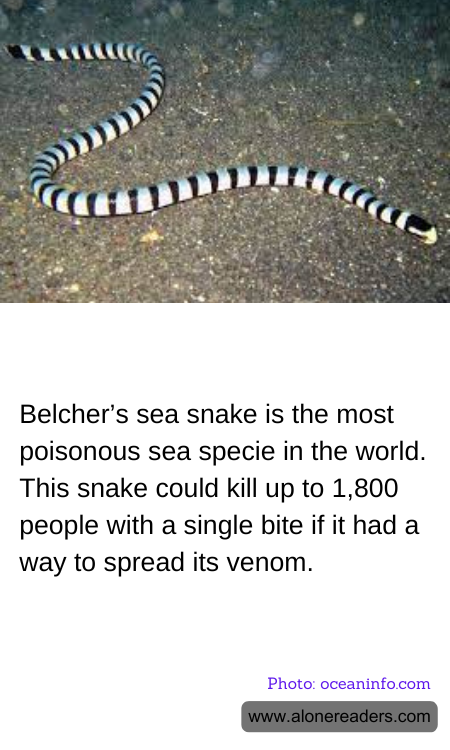
In the vast and mysterious depths of the ocean, where countless creatures dwell, the Belcher’s sea snake stands out as one of the most intriguing and formidable inhabitants. Known scientifically as Hydrophis belcheri, this slender, olive-colored serpent is not only fascinating due to its aquatic adaptations but also because it holds the title of the most venomous sea snake in the world. Despite its small size, the potency of its venom is astonishing, capable of causing unimaginable harm if it were to be effectively delivered to multiple victims.
The Belcher’s sea snake is primarily found in the warm, shallow waters of the Indian Ocean and the coasts of Southeast Asia and Northern Australia. Its habitat includes coral reefs and coastal areas where it can easily hunt for its preferred prey, mainly small fish and eels. The snake’s venom is a complex cocktail of neurotoxins, which can cause paralysis and, ultimately, death. Remarkably, it is estimated that a single bite from this snake could theoretically kill up to 1,800 people, assuming the venom could be distributed evenly and effectively.
Despite its lethal potential, the Belcher’s sea snake is not considered a significant threat to humans. This is largely due to its docile nature and the fact that it rarely comes into contact with people. When encounters do occur, the snake is generally shy and non-aggressive, often choosing to flee rather than fight. Moreover, its fangs are relatively short, which makes it difficult for the snake to deliver a full dose of venom to larger creatures, including humans. As a result, bites are extremely rare, and fatalities are even rarer.
The Belcher’s sea snake serves as a reminder of the incredible diversity and complexity of marine life. Its venom, while dangerous, is also a subject of scientific interest. Researchers are studying the components of the venom for potential medical applications, including the development of new painkillers and treatments for various diseases. This highlights the importance of preserving such species, not only for their ecological roles but also for their potential contributions to human health and medicine.
In conclusion, while the Belcher’s sea snake is indeed the most venomous sea snake known to science, it poses little threat to humans due to its reclusive behavior and the rarity of encounters. It is a fascinating example of nature’s extremes, showcasing both the beauty and danger that coexist in the natural world. As we continue to explore and understand the ocean’s depths, creatures like the Belcher’s sea snake remind us of the delicate balance of life and the potential benefits that can arise from studying even the most dangerous of species.
