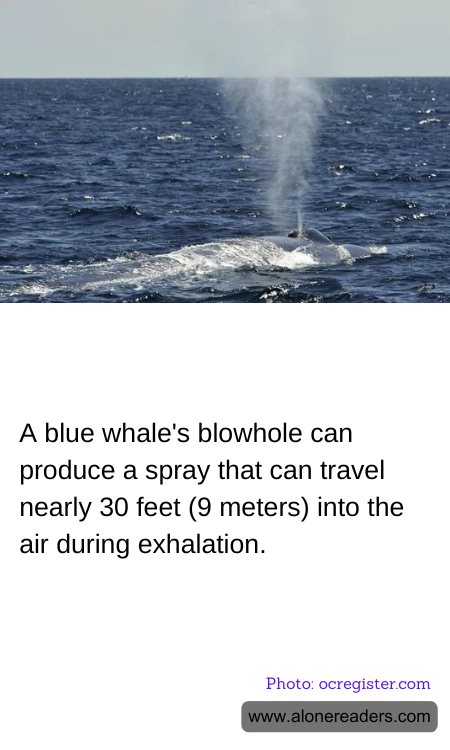
The blue whale, the largest animal to have ever existed on Earth, is a marvel of nature in many ways. Among its most fascinating features is its blowhole, which can produce a spray that travels nearly 30 feet (9 meters) into the air during exhalation. This impressive display is not just a spectacle for onlookers but also a crucial aspect of the whale's respiratory system.
The blowhole of a blue whale is located on the top of its head and functions similarly to a human nose. However, unlike humans, blue whales are voluntary breathers, meaning they consciously decide when to breathe. This adaptation is essential for their survival in the ocean, allowing them to dive deep and remain submerged for extended periods. When a blue whale surfaces, it exhales forcefully through its blowhole, expelling a mixture of air, water vapor, and mucus. This exhalation creates a powerful spout that can reach impressive heights, making it visible from a considerable distance.
The height of the spray is a result of the immense power behind the whale's exhalation. Blue whales have large lungs that can hold a significant volume of air, and when they release this air, it is expelled with great force. This force is necessary to clear the blowhole of any water that may have entered while the whale was submerged. The spray's height is also influenced by the whale's size and the speed at which it exhales. As the largest animal on the planet, the blue whale's sheer size contributes to the magnitude of its spout.
For whale watchers and marine enthusiasts, witnessing a blue whale's spout is a breathtaking experience. It serves as a reminder of the whale's grandeur and the incredible adaptations that have allowed it to thrive in the ocean. The spout is not only a visual spectacle but also an auditory one, as the sound of the exhalation can be heard from a distance, adding to the awe-inspiring nature of the encounter.
Beyond its visual and auditory impact, the blue whale's spout plays a vital role in its biology. By expelling air forcefully, the whale ensures that its lungs are cleared of carbon dioxide and replenished with oxygen, which is crucial for its survival during long dives. This efficient respiratory process is a testament to the evolutionary marvel that is the blue whale, showcasing the intricate balance of form and function in the natural world.
In conclusion, the blue whale's blowhole and its ability to produce a towering spray during exhalation is a remarkable feature that highlights the majesty and complexity of these gentle giants. It serves as a powerful reminder of the wonders of the natural world and the incredible adaptations that have allowed the blue whale to become the ocean's most magnificent inhabitant. Whether observed from the deck of a boat or through the lens of a camera, the sight of a blue whale's spout is an unforgettable experience that captivates people of all ages.
