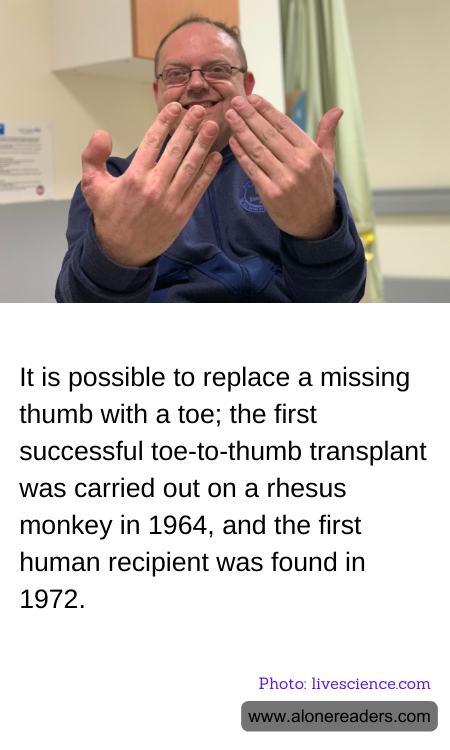
The human body is a marvel of biological engineering, and modern medicine continues to push the boundaries of what is possible in reconstructive surgery. One of the most fascinating developments in this field is the toe-to-thumb transplant, a procedure that has provided hope and functionality to individuals who have lost their thumbs due to injury or illness.
The concept of replacing a missing thumb with a toe might seem unusual at first, but it is grounded in both anatomical similarity and surgical innovation. The thumb is crucial for hand function, enabling us to grasp, pinch, and perform intricate tasks. When a thumb is lost, the impact on daily life can be profound. To address this, surgeons have turned to the foot, where the big toe offers a viable substitute due to its size, structure, and range of motion.
The journey of toe-to-thumb transplantation began in 1964 with a groundbreaking experiment on a rhesus monkey. This pioneering procedure demonstrated the feasibility of using a toe to replace a missing thumb, laying the groundwork for future human applications. The success of this experiment was a testament to the potential of microsurgery, a technique that allows surgeons to connect tiny blood vessels and nerves, ensuring the transplanted digit receives adequate blood flow and sensation.
It wasn't until 1972 that the first human toe-to-thumb transplant was performed. This milestone marked a significant advancement in reconstructive surgery, offering a new lease on life for patients who had previously faced limited options. The procedure involves the careful removal of a toe, typically the big toe, and its transplantation to the hand. Surgeons meticulously connect the bones, tendons, blood vessels, and nerves, a process that requires precision and expertise.
The results of a successful toe-to-thumb transplant can be life-changing. Patients often regain a significant degree of hand function, allowing them to perform tasks that were once impossible. While the aesthetic difference between a thumb and a toe may be noticeable, the functional benefits far outweigh any cosmetic concerns. Moreover, the human body is remarkably adaptable, and many patients report that their new thumb feels natural over time.
As with any surgical procedure, there are risks and considerations. The loss of a toe can affect balance and gait, although most patients adapt well. Advances in surgical techniques and postoperative care continue to improve outcomes, making toe-to-thumb transplantation a viable option for many individuals.
The story of toe-to-thumb transplantation is a testament to human ingenuity and the relentless pursuit of solutions to complex medical challenges. It highlights the incredible adaptability of the human body and the power of modern medicine to restore not just function, but also quality of life. As surgical techniques continue to evolve, the possibilities for reconstructive surgery are boundless, offering hope to those in need of innovative solutions.
