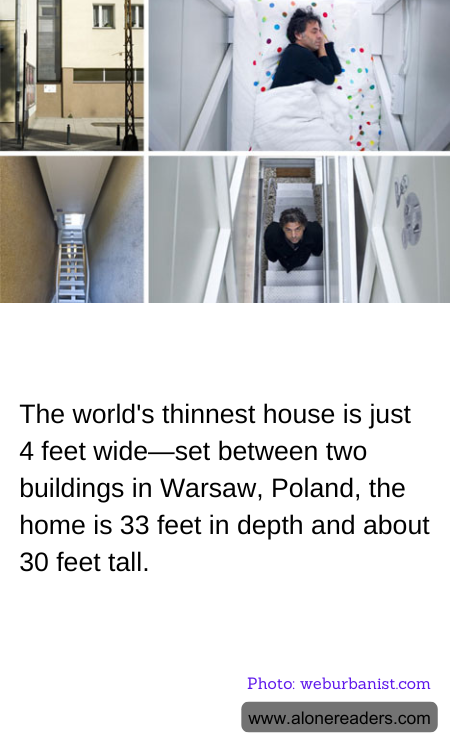
Nestled inconspicuously between two towering buildings in Warsaw, Poland, stands a marvel of architectural ingenuity: the world’s thinnest house. Known as the Keret House, this extraordinary structure measures a mere four feet in width, yet it defies expectations with its clever use of space and innovative design. Despite its slender frame, the house stretches 33 feet in depth and rises approximately 30 feet in height, offering a unique living experience that challenges conventional notions of what a home can be.
The Keret House was conceived by Polish architect Jakub Szczesny and completed in 2012. It was named after Israeli writer Etgar Keret, who was the first tenant and whose work often explores themes of space and confinement. The house was designed as an artistic installation and a functional residence, intended to serve as a temporary home for traveling writers and artists. Its creation was driven by the desire to fill an unused urban space, transforming it into a symbol of creativity and resourcefulness.
Inside, the house is a testament to minimalist living. Despite its narrow dimensions, the interior is surprisingly functional, featuring a kitchen, bathroom, living area, and sleeping quarters. The design maximizes every inch of space, with custom-built furniture and fixtures that fold away or serve multiple purposes. The walls and ceiling are painted white, enhancing the sense of openness and light. Large windows and translucent panels allow natural light to flood the interior, creating an airy atmosphere that belies the house’s compact size.
Living in the Keret House requires a shift in perspective, embracing simplicity and efficiency. It challenges its inhabitants to reconsider their relationship with space and possessions, encouraging a lifestyle that prioritizes experiences over material accumulation. The house stands as a poignant reminder of the potential for innovation in urban environments, where space is often at a premium.
The Keret House has captured the imagination of people worldwide, becoming a symbol of architectural creativity and the possibilities of modern design. It has sparked discussions about urban living, sustainability, and the future of housing in densely populated cities. As cities continue to grow and space becomes increasingly scarce, the Keret House offers a glimpse into how we might adapt to these challenges, using design to create functional and inspiring living spaces in the most unlikely of places.
In a world where bigger is often seen as better, the Keret House stands as a testament to the power of small. It invites us to rethink our assumptions about space and to appreciate the beauty and potential of the unconventional. Whether as a temporary home for artists or a symbol of architectural innovation, the world’s thinnest house continues to inspire and intrigue, proving that even the narrowest of spaces can hold limitless possibilities.
