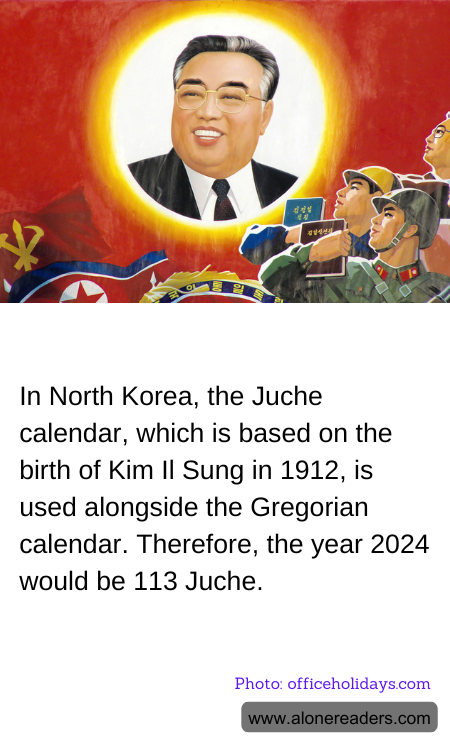
In the enigmatic nation of North Korea, time is marked not only by the familiar Gregorian calendar but also by a unique system known as the Juche calendar. This calendar, deeply rooted in the country's ideological framework, begins its count from the birth year of Kim Il Sung, the founding leader of North Korea. Born in 1912, Kim Il Sung is revered as the Eternal President, and his birth year marks the beginning of the Juche era. Consequently, while the rest of the world will recognize the year 2024, North Koreans will simultaneously observe the year 113 Juche.
The Juche calendar is more than just a method of marking time; it is a reflection of North Korea's distinct political and cultural identity. Juche, which translates to "self-reliance," is the guiding philosophy of the nation, emphasizing independence and self-sufficiency. This ideology permeates all aspects of North Korean life, including its calendar system. By anchoring their calendar to Kim Il Sung's birth, North Koreans underscore the centrality of his legacy and the enduring influence of his leadership on the country's development.
The coexistence of the Juche and Gregorian calendars in North Korea is a fascinating example of how cultural and political narratives can shape the perception of time. While the Gregorian calendar is used internationally and is essential for global interactions, the Juche calendar serves as a constant reminder of the nation's unique path and its ideological foundations. This dual system allows North Koreans to engage with the world while maintaining a distinct national identity.
For outsiders, the Juche calendar may seem like an intriguing historical footnote, but for North Koreans, it is a daily reminder of their country's history and values. It is a testament to the enduring legacy of Kim Il Sung and the principles he espoused. As the world moves into 2024, North Koreans will enter 113 Juche, continuing to honor their past while navigating the challenges of the present.
Understanding the Juche calendar provides a window into the complex interplay of history, ideology, and identity in North Korea. It highlights the ways in which nations can construct unique systems to reflect their values and priorities. As we observe the passage of time in our own ways, the Juche calendar serves as a reminder of the diverse ways in which human societies interpret and commemorate the passage of years.
