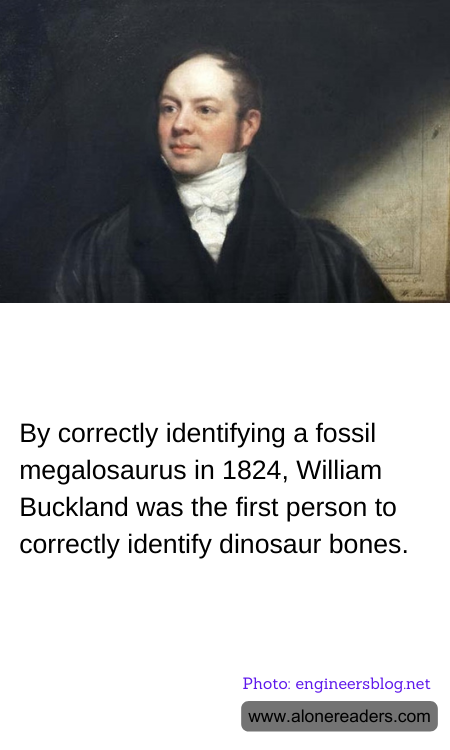
In the early 19th century, the world of paleontology was still in its infancy, with many fossil discoveries shrouded in mystery and misinterpretation. It was during this time that a significant breakthrough occurred, thanks to the keen observations of William Buckland, a British geologist and paleontologist. In 1824, Buckland made history by being the first person to correctly identify dinosaur bones, specifically those of a Megalosaurus, marking a pivotal moment in the study of prehistoric life.
William Buckland was a man of many talents, known for his engaging lectures and a passion for the natural world. His interest in fossils led him to examine a collection of large bones that had been unearthed in the Stonesfield quarry near Oxford, England. These bones were unlike anything previously documented, and their sheer size suggested they belonged to a creature of immense proportions. At the time, the concept of dinosaurs was not yet established, and such fossils were often misidentified as belonging to giant lizards or other large reptiles.
Buckland's meticulous study of the Stonesfield fossils led him to conclude that they represented a new genus of reptile, which he named Megalosaurus, meaning "great lizard." His findings were published in a paper titled "Notice on the Megalosaurus or Great Fossil Lizard of Stonesfield," presented to the Geological Society of London. This publication was groundbreaking, as it was the first scientific description of what we now recognize as a dinosaur.
The identification of Megalosaurus by Buckland was more than just a scientific achievement; it laid the groundwork for future discoveries and the eventual recognition of dinosaurs as a distinct group of prehistoric animals. Buckland's work inspired other scientists, including Richard Owen, who would later coin the term "dinosaur" in 1842, further solidifying the significance of Buckland's initial discovery.
Buckland's contribution to paleontology extends beyond the identification of Megalosaurus. His work helped to shift the scientific community's understanding of Earth's history and the creatures that once roamed its surface. By correctly identifying the Megalosaurus fossils, Buckland opened the door to a new era of paleontological exploration, sparking curiosity and research that continues to this day.
In retrospect, William Buckland's identification of Megalosaurus was a monumental step in the field of paleontology. It not only marked the first correct identification of dinosaur bones but also set the stage for the rich and fascinating study of dinosaurs that captivates scientists and enthusiasts alike. His legacy endures as a testament to the power of observation and the relentless pursuit of knowledge, reminding us of the wonders that lie hidden beneath the surface of our world.
