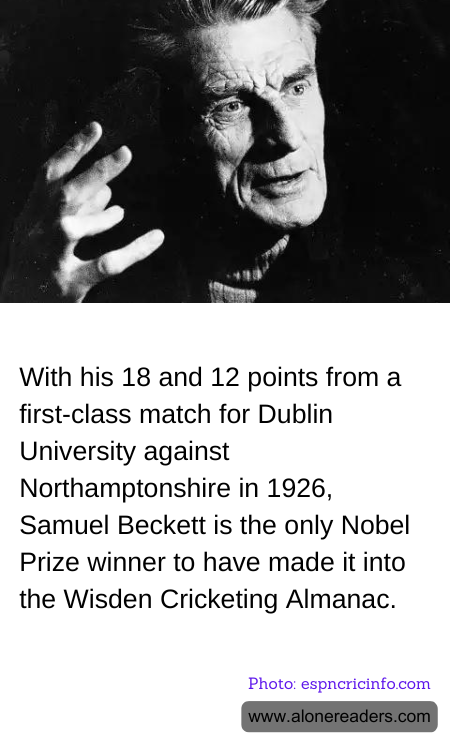
In the annals of both literature and sports, few figures stand as uniquely positioned as Samuel Beckett, the celebrated playwright and novelist. Known for his profound contributions to modernist literature, Beckett's name is etched in history as the author of "Waiting for Godot" and as a Nobel Prize laureate in Literature. However, beyond the realm of existential musings and avant-garde narratives, Beckett holds a distinct accolade that bridges the worlds of literature and cricket. He is the only Nobel Prize winner to have been featured in the Wisden Cricketers' Almanack, a testament to his multifaceted talents.
In 1926, long before Beckett's literary genius would captivate the world, he was a young man with a passion for cricket. Playing for Dublin University, Beckett participated in a first-class match against Northamptonshire, a fixture that would inadvertently secure his place in cricketing history. During this match, Beckett scored 18 and 12 runs, modest figures by professional standards, yet significant enough to earn him a mention in the revered Wisden Cricketers' Almanack. This achievement, while perhaps a footnote in the grand tapestry of his life, highlights a lesser-known facet of Beckett's early years.
Cricket, with its intricate blend of strategy, patience, and skill, mirrors the complexity and depth found in Beckett's literary works. The game requires a contemplative mindset, much like the introspective nature of Beckett's writing. His involvement in cricket during his formative years may have subtly influenced his narrative style, characterized by its meticulous attention to detail and profound exploration of the human condition. The discipline and focus required on the cricket field could well have paralleled the precision and thoughtfulness evident in his prose and plays.
Beckett's inclusion in the Wisden Cricketers' Almanack serves as a reminder of the diverse paths that can lead to greatness. It underscores the idea that talents can manifest in myriad forms, often intersecting in unexpected ways. While his cricketing exploits may not have reached the heights of his literary achievements, they nonetheless contribute to the rich tapestry of his life, offering a glimpse into the varied interests that shaped his worldview.
For enthusiasts of both literature and cricket, Beckett's dual legacy is a source of fascination and inspiration. It challenges the notion of singular identity, illustrating how one's passions can coexist and complement each other. Samuel Beckett's journey from the cricket fields of Dublin to the Nobel Prize stage is a testament to the boundless potential of human creativity and the unexpected intersections that define a life well-lived.
