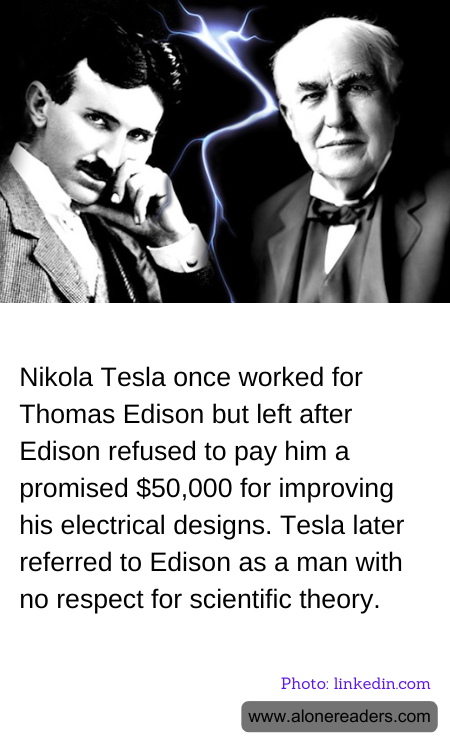
In the annals of scientific history, few relationships are as intriguing as that between Nikola Tesla and Thomas Edison. Both were titans of innovation, yet their paths diverged dramatically, fueled by differing philosophies and a pivotal financial dispute. Tesla, a visionary inventor from Serbia, arrived in the United States in 1884, eager to work under the renowned Edison. At the time, Edison was already a celebrated figure, having invented the phonograph and developed the incandescent light bulb. Tesla, with his own burgeoning ideas, saw an opportunity to contribute to Edison's burgeoning empire.
Tesla's tenure with Edison was marked by a significant promise. Edison, recognizing Tesla's potential, allegedly offered him $50,000 to improve the efficiency of his direct current (DC) generators. Tesla, driven by both ambition and necessity, accepted the challenge and set to work. After months of toil, Tesla succeeded in enhancing the designs, expecting to receive the promised reward. However, when he approached Edison for the payment, he was met with a dismissive response. Edison reportedly told Tesla that the offer had been a joke, and instead offered a modest raise of $10 per week. Disillusioned and feeling betrayed, Tesla resigned from Edison's company.
This incident was more than just a financial disagreement; it highlighted a fundamental clash in their approaches to science and innovation. Edison was a practical inventor, often relying on trial and error rather than theoretical understanding. In contrast, Tesla was a proponent of scientific theory, believing that a deep understanding of the underlying principles was essential for true innovation. Tesla later remarked that Edison had "no respect for scientific theory," a sentiment that underscored their philosophical divide.
The fallout from this episode set the stage for one of the most famous rivalries in technological history: the War of Currents. Edison championed direct current (DC) for electrical power distribution, while Tesla, backed by industrialist George Westinghouse, advocated for alternating current (AC). AC ultimately proved to be more efficient for long-distance power transmission and became the standard, cementing Tesla's legacy as a pioneer of modern electricity.
Despite their differences, both men left indelible marks on the world. Edison's contributions laid the groundwork for the modern electric utility industry, while Tesla's innovations in AC power, radio, and wireless communication continue to influence technology today. Their story serves as a reminder of the complex interplay between personality, philosophy, and progress in the realm of invention. As history often shows, the path to innovation is rarely straightforward, and the legacies of Tesla and Edison are testament to the enduring impact of their divergent visions.
