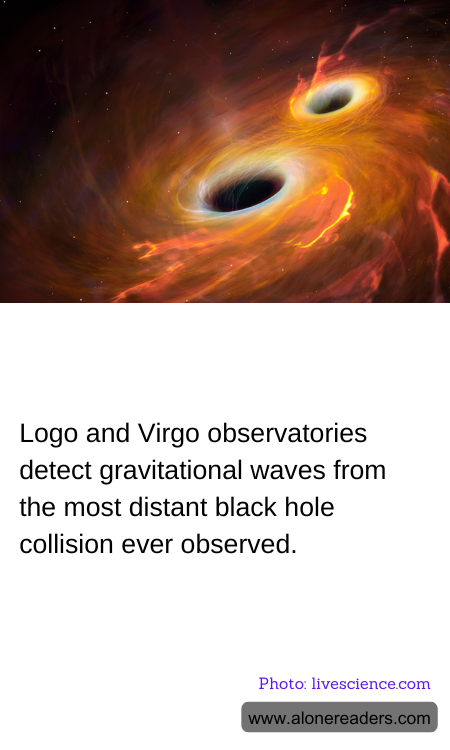
In a groundbreaking discovery that has captivated the scientific community and the public alike, the LIGO (Laser Interferometer Gravitational-Wave Observatory) and Virgo observatories have detected gravitational waves from the most distant black hole collision ever observed. This monumental event marks a significant milestone in our understanding of the universe, offering new insights into the nature of black holes and the fabric of space-time.
Gravitational waves are ripples in space-time caused by some of the most violent and energetic processes in the universe. Predicted by Albert Einstein in 1916 as part of his general theory of relativity, these waves were first directly observed by LIGO in 2015. Since then, the detection of gravitational waves has opened a new window into the cosmos, allowing scientists to observe cosmic events that were previously invisible.
The recent detection involved two black holes merging in a cataclysmic collision that occurred billions of light-years away from Earth. This event is not only the most distant black hole merger ever observed but also one of the most massive, with the resulting black hole weighing in at an astonishing 142 times the mass of our Sun. The collision released an enormous amount of energy, equivalent to several solar masses, in the form of gravitational waves that traveled across the universe before reaching Earth.
The detection was made possible by the advanced capabilities of the LIGO and Virgo observatories, which are designed to measure incredibly small disturbances in space-time caused by passing gravitational waves. These observatories use laser interferometry to detect changes in distance smaller than a fraction of a proton's diameter, allowing them to capture the faint signals from such distant cosmic events.
This discovery is significant for several reasons. Firstly, it provides valuable data about the population of black holes in the universe, particularly those that are extremely massive and located at great distances. Secondly, it offers insights into the processes that lead to the formation and growth of black holes, as well as the environments in which they exist. Lastly, it serves as a testament to the power of international collaboration in advancing our understanding of the universe, with scientists from around the world contributing to the analysis and interpretation of the data.
As we continue to explore the universe through the lens of gravitational wave astronomy, discoveries like this one will undoubtedly lead to new questions and challenges. The detection of such distant black hole collisions not only enriches our knowledge of the cosmos but also inspires future generations of scientists to push the boundaries of what is possible. With each new observation, we come closer to unraveling the mysteries of the universe and our place within it.
