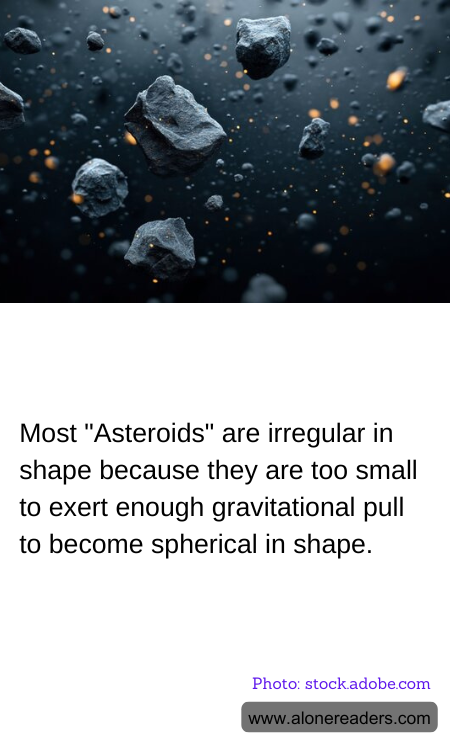
Asteroids, the rocky remnants from the early formation of our solar system, are fascinating celestial bodies that capture the imagination of scientists and space enthusiasts alike. These objects, primarily found in the asteroid belt between Mars and Jupiter, vary significantly in size, composition, and shape. One intriguing aspect of asteroids is their irregular shapes, which can often resemble anything from a potato to a jagged rock. This irregularity is primarily due to their size and the gravitational forces at play.
The shape of an asteroid is largely determined by its mass and the gravitational pull it can exert. Gravity is the force that pulls objects toward one another, and it plays a crucial role in shaping celestial bodies. For an object to become spherical, it must have enough mass for its gravity to pull equally in all directions, smoothing out any irregularities over time. This process is known as hydrostatic equilibrium. However, most asteroids are simply too small to generate the necessary gravitational force to achieve this state.
Asteroids can range in size from a few meters to hundreds of kilometers in diameter. The largest known asteroid, Ceres, is about 940 kilometers across and is massive enough to be classified as a dwarf planet, exhibiting a nearly spherical shape. In contrast, smaller asteroids, which make up the majority, lack the mass required to overcome the structural integrity of their rocky material. As a result, they retain their irregular shapes, often characterized by craters, ridges, and valleys formed by collisions with other space debris.
The irregular shapes of asteroids also provide valuable insights into their history and composition. These shapes can reveal information about the asteroid's past collisions and the forces it has experienced over billions of years. By studying the surface features and shapes of asteroids, scientists can learn more about the conditions of the early solar system and the processes that led to the formation of planets.
In recent years, space missions have provided us with detailed images and data about asteroids, further enhancing our understanding of these intriguing objects. Missions like NASA's OSIRIS-REx and Japan's Hayabusa2 have visited asteroids Bennu and Ryugu, respectively, capturing high-resolution images that showcase their irregular shapes and diverse surface features. These missions aim to collect samples and return them to Earth, offering a closer look at the building blocks of our solar system.
In conclusion, the irregular shapes of most asteroids are a direct result of their small size and insufficient gravitational pull to form a spherical shape. These rocky bodies offer a glimpse into the early solar system and continue to be a subject of scientific interest and exploration. As we learn more about asteroids, we not only gain insights into the past but also prepare for future endeavors, such as asteroid mining and planetary defense, ensuring that these celestial wanderers remain a source of wonder and discovery for generations to come.
