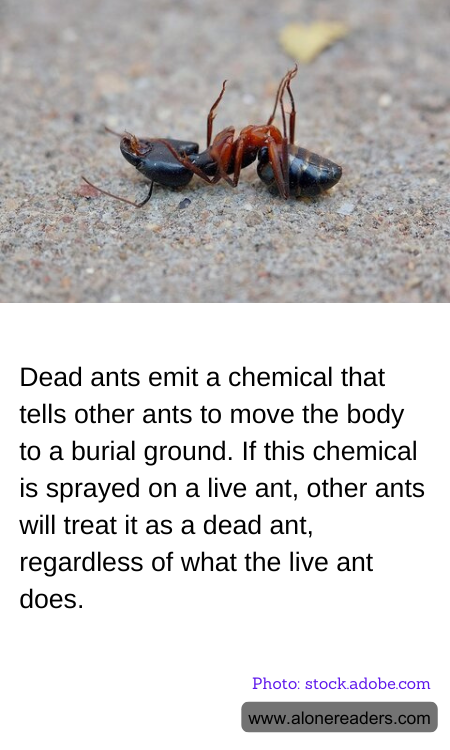
In the intricate world of ants, communication is key to maintaining the order and efficiency of their colonies. One of the most fascinating aspects of their communication is how they handle their dead. When an ant dies, it emits a specific chemical signal that alerts its fellow ants to the presence of a corpse. This chemical, primarily composed of oleic acid, acts as a death cue, prompting other ants to transport the deceased to a designated burial area, effectively keeping the colony clean and free from potential disease.
This behavior is not just a testament to the ants' organizational skills but also highlights the power of chemical communication in the animal kingdom. The presence of oleic acid on a dead ant triggers a response from the living ants, who instinctively carry the body away. This process is so ingrained in their behavior that if the same chemical is artificially applied to a living ant, its peers will treat it as if it were dead. Regardless of the live ant's attempts to move or resist, it will be picked up and taken to the burial site, illustrating the ants' reliance on chemical cues over visual or behavioral ones.
The implications of this behavior are both intriguing and profound. It underscores the importance of chemical signals in the social structure of ant colonies, where individual actions are often dictated by the collective needs of the group. This chemical communication ensures that the colony remains hygienic and reduces the risk of disease spread, which is crucial for the survival of the colony. Moreover, it demonstrates how ants prioritize the chemical signals over other sensory inputs, a strategy that has likely evolved to enhance the efficiency and survival of their communities.
For scientists and entomologists, this phenomenon offers a window into the complex social dynamics of ants and raises questions about the evolution of communication in other species. It also provides insights into how simple chemical signals can govern complex social behaviors, a concept that could have applications in robotics and artificial intelligence, where similar principles could be used to coordinate the actions of autonomous agents.
In conclusion, the chemical communication system of ants, particularly their method of dealing with the dead, is a remarkable example of nature's ingenuity. It highlights the sophisticated social structures that can arise from simple organisms and offers valuable lessons in the power of non-verbal communication. As we continue to study these tiny creatures, we gain a deeper appreciation for the complexities of life and the myriad ways in which living organisms interact with their environment.
