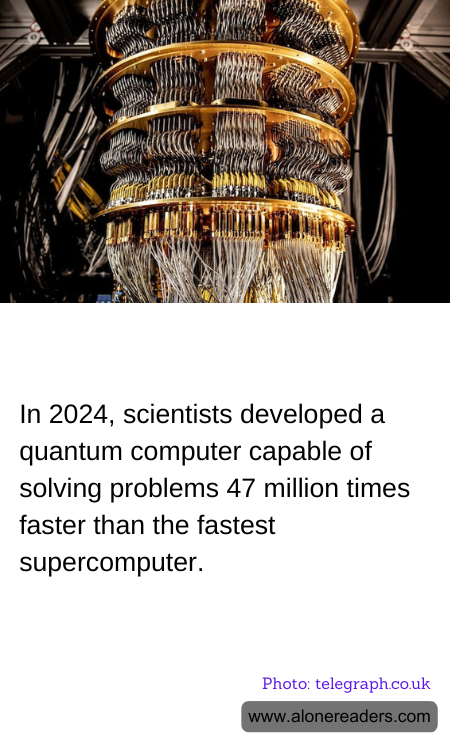
In a groundbreaking development that has sent ripples through the scientific community and beyond, 2024 marks the year when scientists unveiled a quantum computer capable of solving problems 47 million times faster than the fastest supercomputer. This monumental achievement not only represents a significant leap in computational power but also opens up a realm of possibilities across various fields, from cryptography to drug discovery.
Quantum computing, a field that has been the subject of intense research and speculation for decades, leverages the principles of quantum mechanics to process information in fundamentally different ways compared to classical computers. While traditional computers use bits as the smallest unit of data, quantum computers use quantum bits, or qubits. These qubits can exist in multiple states simultaneously, thanks to the principles of superposition and entanglement, allowing quantum computers to perform complex calculations at unprecedented speeds.
The new quantum computer's ability to outperform the fastest supercomputers by such a staggering margin is a testament to the rapid advancements in quantum technology. This breakthrough is expected to revolutionize industries that rely heavily on computational power. For instance, in the field of cryptography, quantum computers could potentially crack encryption codes that would take classical computers millennia to solve, prompting a reevaluation of current security protocols. Similarly, in pharmaceuticals, the ability to simulate molecular interactions at such high speeds could accelerate drug discovery processes, leading to faster development of new treatments and therapies.
Moreover, the implications of this quantum leap extend to artificial intelligence and machine learning, where the ability to process vast amounts of data quickly can lead to more sophisticated and efficient algorithms. This could enhance everything from personalized medicine to autonomous vehicles, making them more reliable and effective.
Despite the excitement surrounding this technological marvel, it also raises important questions and challenges. The sheer power of quantum computing necessitates a reevaluation of ethical considerations, particularly in areas like data privacy and security. As with any powerful tool, the potential for misuse exists, and it will be crucial for policymakers, scientists, and ethicists to work together to ensure that the benefits of quantum computing are harnessed responsibly.
As we stand on the brink of a new era in computing, the development of this quantum computer serves as a reminder of the boundless potential of human ingenuity. It challenges us to rethink what is possible and inspires a future where the limits of technology are continually pushed. While the journey of quantum computing is just beginning, its impact is already being felt, promising a future where the impossible becomes possible, and the unimaginable becomes reality.
