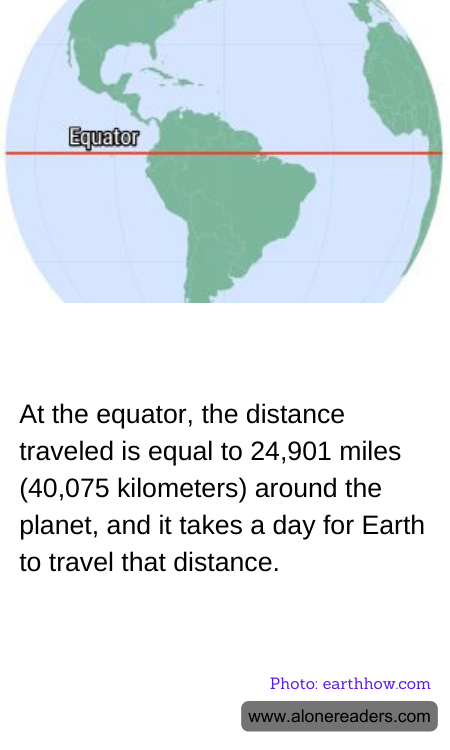
The Earth is a fascinating celestial body, and one of its most intriguing features is its equator. The equator is an imaginary line that circles the globe, dividing it into the Northern and Southern Hemispheres. This line is not just a geographical marker; it represents a significant aspect of Earth's rotation and its journey through space. At the equator, the circumference of the Earth measures approximately 24,901 miles, or 40,075 kilometers. This immense distance is traveled by the planet in a single day, showcasing the incredible speed and precision of Earth's rotation.
The concept of the equator is not only a geographical curiosity but also a fundamental aspect of our understanding of time and space. As the Earth rotates on its axis, it completes one full rotation every 24 hours. This rotation is what gives us the cycle of day and night. At the equator, the speed of rotation is at its maximum, with the Earth moving at about 1,037 miles per hour (1,670 kilometers per hour). This rapid movement is a testament to the dynamic nature of our planet and plays a crucial role in maintaining the balance of life on Earth.
The equator is also significant in terms of climate and biodiversity. Regions along the equator experience relatively consistent weather patterns, with little variation in temperature throughout the year. This stability creates ideal conditions for diverse ecosystems to thrive. Rainforests, such as the Amazon in South America and the Congo Basin in Africa, are located near the equator and are home to an astonishing variety of plant and animal species. These ecosystems are vital to the health of our planet, as they contribute to oxygen production and carbon dioxide absorption, playing a crucial role in regulating the Earth's climate.
Moreover, the equator serves as a reference point for navigation and timekeeping. The concept of latitude, which measures how far north or south a location is from the equator, is essential for mapping and navigation. Additionally, the equator is used to define time zones, with the Prime Meridian in Greenwich, England, serving as the starting point for measuring time around the world. This system allows for the coordination of activities across different regions, facilitating global communication and commerce.
In conclusion, the equator is much more than just an imaginary line on a map. It is a vital component of our planet's structure and function, influencing everything from climate and biodiversity to navigation and timekeeping. The fact that the Earth travels 24,901 miles around the equator in just one day is a remarkable demonstration of the planet's dynamic nature. Understanding the equator and its significance helps us appreciate the complexity and beauty of the world we inhabit, reminding us of the interconnectedness of all life on Earth.
