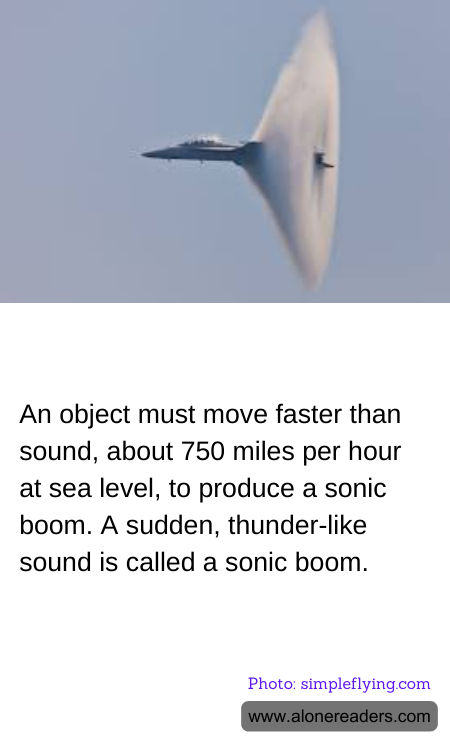
A sonic boom is a fascinating phenomenon that captures the imagination of people of all ages. It occurs when an object travels through the air at a speed faster than sound, which is approximately 750 miles per hour at sea level. This speed is known as the speed of sound, or Mach 1. When an object surpasses this speed, it creates a sudden, thunder-like sound known as a sonic boom.
The science behind a sonic boom is rooted in the way sound waves behave. As an object moves through the air, it generates sound waves that travel outward in all directions. When the object is moving slower than the speed of sound, these waves spread out smoothly. However, when the object accelerates to speeds exceeding the speed of sound, the sound waves are compressed together because they cannot move out of the way quickly enough. This compression forms a shock wave, which is heard on the ground as a sonic boom.
The experience of a sonic boom is often startling. It can be likened to the sound of a thunderclap, and it is powerful enough to rattle windows and shake buildings. The intensity of the boom depends on several factors, including the size, shape, and speed of the object, as well as the altitude at which it is traveling. Generally, the closer the object is to the ground, the louder the boom will be.
Sonic booms are most commonly associated with supersonic aircraft, such as military jets and the now-retired Concorde passenger plane. These aircraft are designed to travel at speeds that exceed the speed of sound, allowing them to cover great distances in a short amount of time. However, the loud noise generated by sonic booms has led to restrictions on supersonic flight over populated areas, as it can be disruptive to people and animals.
Despite these restrictions, the study of sonic booms continues to be an important area of research. Scientists and engineers are working to develop new technologies that can reduce the noise associated with supersonic travel. These efforts include designing aircraft with special shapes that minimize shock waves and exploring alternative flight paths that avoid populated areas.
In conclusion, the sonic boom is a remarkable demonstration of the principles of physics and the capabilities of modern technology. While it may be startling to hear, it represents the cutting edge of human achievement in aviation. As research progresses, we may see new advancements that allow for quieter and more efficient supersonic travel, opening up new possibilities for transportation and exploration.
