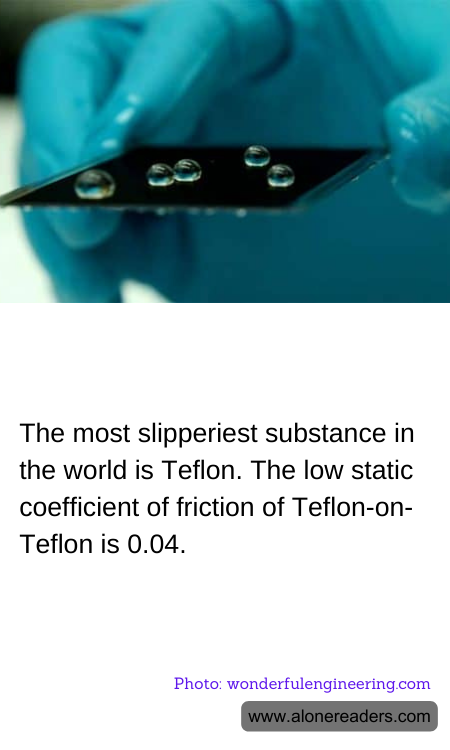
In the world of materials science, few substances have captured the imagination and utility of both scientists and everyday users like Teflon. Known for its remarkable slipperiness, Teflon has become synonymous with non-stick cookware, but its applications extend far beyond the kitchen. The key to Teflon's unique properties lies in its exceptionally low static coefficient of friction, particularly when Teflon surfaces slide against each other. This coefficient is a mere 0.04, making it one of the slipperiest substances known to humanity.
Teflon, scientifically known as polytetrafluoroethylene (PTFE), was discovered by accident in 1938 by Dr. Roy Plunkett while he was working for DuPont. Initially, the substance was not recognized for its potential, but over time, its unique properties became apparent. The low friction of Teflon is due to its molecular structure, which consists of carbon atoms surrounded by fluorine atoms. This configuration creates a surface that is not only slippery but also resistant to sticking, making it ideal for a variety of applications.
The most common use of Teflon is in non-stick cookware, where its ability to prevent food from adhering to the surface has revolutionized cooking and cleaning. However, Teflon's applications are not limited to the culinary world. In the industrial sector, Teflon is used in machinery and equipment where reducing friction is crucial. Its low friction properties help in minimizing wear and tear, thereby extending the lifespan of mechanical components. Additionally, Teflon is used in the aerospace industry, where its lightweight and durable nature is invaluable.
Beyond its practical applications, Teflon's slipperiness has also sparked interest in scientific research. Engineers and scientists study Teflon to develop new materials and coatings that can mimic its properties. This research has the potential to lead to innovations in fields ranging from medical devices to sports equipment, where reducing friction can enhance performance and efficiency.
Despite its many advantages, Teflon is not without its challenges. When heated to very high temperatures, it can release fumes that may be harmful if inhaled. Therefore, it is essential to use Teflon-coated products within their recommended temperature ranges to ensure safety. Moreover, the environmental impact of Teflon production and disposal is an area of ongoing research and development, as scientists seek to create more sustainable alternatives.
In conclusion, Teflon's status as the slipperiest substance in the world is well-deserved. Its low static coefficient of friction makes it an invaluable material across various industries, from household kitchens to high-tech aerospace applications. As research continues, the potential for new and innovative uses of Teflon and similar materials promises to keep this remarkable substance at the forefront of scientific and industrial advancement. Whether in everyday life or cutting-edge technology, Teflon's legacy as a marvel of modern chemistry is assured.
