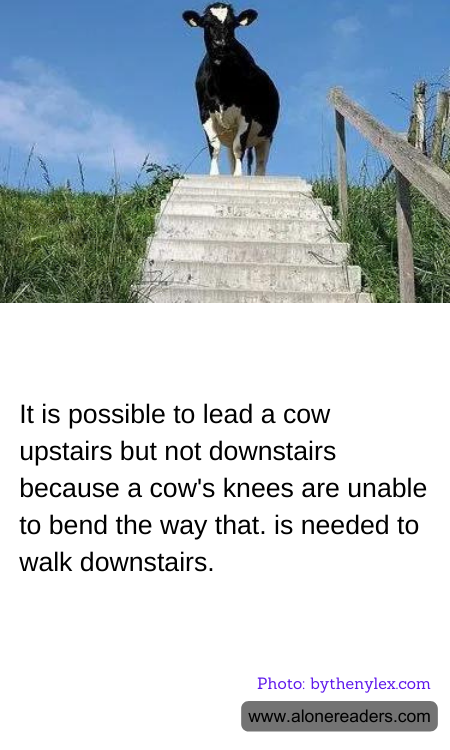
Leading a cow upstairs might sound like an unusual endeavor, but it is indeed possible due to the unique structure of a cow's legs. However, the reverse journey—leading a cow downstairs—presents a significant challenge. This peculiar situation arises from the anatomy of a cow's knees, which are not designed to bend in a way that facilitates descending stairs.
Cows, like many other quadrupeds, have a skeletal structure that supports their large bodies and allows them to graze and move across flat or gently sloping terrain. Their knees, specifically, are adapted for walking on level ground. The front legs of a cow have joints that function similarly to elbows in humans, while the hind legs have joints that resemble human knees. These joints are designed to support the cow's weight and provide stability, but they lack the flexibility required for descending steep inclines or stairs.
When a cow is led upstairs, the process is relatively straightforward. The cow's legs can extend forward, allowing it to climb each step with a degree of ease. The upward motion is supported by the cow's strong hindquarters, which propel it forward and upward. However, when it comes to descending, the cow's anatomy becomes a hindrance. The downward motion requires the knees to bend in a way that they are not naturally inclined to do, making it difficult and potentially dangerous for the cow to navigate stairs.
This limitation is not just a quirky fact but also a consideration for farmers and those who work with cattle. Understanding the physical constraints of cows is crucial for ensuring their safety and well-being. For instance, when designing barns or enclosures, it is important to avoid structures that require cows to navigate stairs. Instead, ramps or gently sloping paths are preferable, as they accommodate the natural movement of the animals.
The inability of cows to descend stairs safely also highlights the importance of considering animal anatomy and behavior in agricultural practices. It serves as a reminder that while animals can sometimes be coaxed into unfamiliar situations, their physical limitations must always be respected. This understanding fosters a more humane and practical approach to animal husbandry, ensuring that the needs and capabilities of the animals are prioritized.
In conclusion, while it may be possible to lead a cow upstairs, the journey downstairs is fraught with difficulty due to the cow's knee structure. This fascinating aspect of bovine anatomy underscores the importance of designing environments that cater to the natural abilities of animals, ensuring their safety and comfort in human-managed settings.
