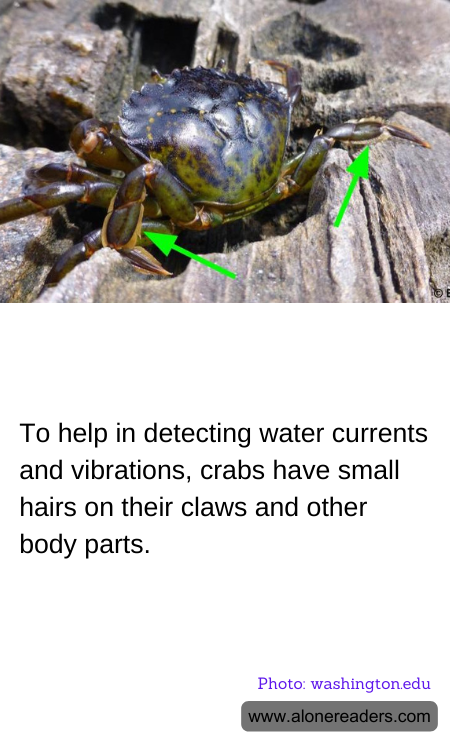
Crabs, those fascinating creatures that scuttle along the ocean floor, have long intrigued scientists and nature enthusiasts alike. One of the most remarkable features of crabs is their ability to detect water currents and vibrations in their environment. This ability is crucial for their survival, helping them find food, avoid predators, and navigate their often-turbulent habitats. The secret to this remarkable sensory capability lies in the tiny hairs that cover their claws and other parts of their bodies.
These small hairs, known as setae, are incredibly sensitive to changes in the surrounding water. They function much like the whiskers of a cat, providing the crab with detailed information about its environment. When water currents or vibrations pass over these hairs, they bend and send signals to the crab's nervous system. This allows the crab to detect even the slightest movements in the water, which can indicate the presence of prey or the approach of a predator.
The setae are not uniformly distributed over the crab's body but are strategically located to maximize their effectiveness. The claws, in particular, are densely covered with these hairs, as they are often the first point of contact with the environment. This strategic placement allows crabs to quickly assess their surroundings and react accordingly. For instance, when a potential threat is detected, a crab can swiftly retreat into its burrow or adopt a defensive posture.
In addition to aiding in predator detection, these sensory hairs play a vital role in the crab's ability to find food. Many crabs are scavengers, relying on their keen sense of touch and vibration to locate food particles in the sand or water. The setae help them detect the movement of small prey or the presence of organic material, guiding them to potential meals. This ability is particularly important in the often murky waters where visibility is limited.
The study of these sensory hairs has not only provided insights into the behavior and ecology of crabs but has also inspired technological advancements. Researchers are exploring ways to mimic the sensitivity of crab setae in the development of underwater sensors and robotics. By understanding how crabs perceive their environment, scientists hope to create devices that can detect changes in water currents and vibrations with similar precision.
In conclusion, the small hairs on crabs' claws and bodies are a testament to the wonders of nature's design. These tiny structures enable crabs to navigate their complex environments with remarkable efficiency, ensuring their survival in the ever-changing underwater world. As we continue to study these fascinating creatures, we gain not only a deeper appreciation for their adaptability but also valuable insights that could influence future technological innovations.
