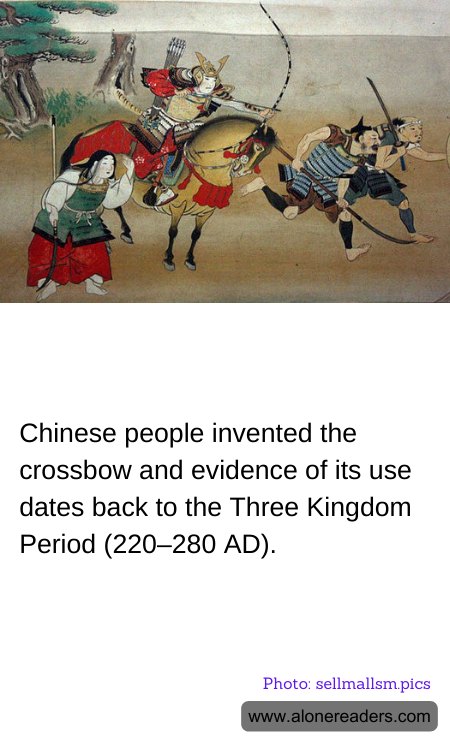
The crossbow, a remarkable invention that revolutionized ancient warfare, has its origins deeply rooted in Chinese history. The ingenuity of the Chinese people in creating this formidable weapon is a testament to their advanced understanding of mechanics and military strategy. Evidence of the crossbow's use can be traced back to the tumultuous era of the Three Kingdoms Period (220–280 AD), a time marked by intense conflict and political fragmentation in China.
The crossbow was a significant advancement over traditional bows due to its mechanical design, which allowed for greater power and accuracy. Unlike a conventional bow, the crossbow could be pre-loaded and held in a ready position, enabling the user to aim more precisely and shoot with minimal physical exertion. This made it an ideal weapon for soldiers who required less training compared to those using longbows, thus broadening the scope of military recruitment and enhancing the effectiveness of armies.
During the Three Kingdoms Period, China was divided into three rival states: Wei, Shu, and Wu. This era was characterized by continuous warfare as each state vied for dominance over the others. The crossbow played a crucial role in these military campaigns, providing a strategic advantage to the armies that wielded it. Historical records and archaeological findings have revealed that crossbows were not only used in open battles but also in sieges, where their ability to penetrate armor and fortifications proved invaluable.
The design of the ancient Chinese crossbow was sophisticated, featuring a horizontal bow mounted on a wooden stock with a trigger mechanism. This allowed for a more stable and controlled release of the bolt, the projectile used in crossbows. The materials used in constructing these weapons were carefully selected to ensure durability and efficiency, with bronze often being used for the trigger mechanisms due to its strength and resistance to wear.
The impact of the crossbow extended beyond the battlefield. It influenced the development of military tactics and strategies, as armies had to adapt to the new capabilities and threats posed by this weapon. The crossbow's ability to pierce armor and its relatively easy operation meant that it could be used effectively by a wide range of soldiers, from seasoned warriors to newly recruited infantry.
The legacy of the Chinese crossbow is evident in its continued use and evolution throughout history. It laid the groundwork for future innovations in weaponry and remains a symbol of the ingenuity and resourcefulness of ancient Chinese civilization. The crossbow's invention during the Three Kingdoms Period not only highlights the technological advancements of the time but also underscores the enduring impact of Chinese contributions to military technology. As we reflect on this period, we gain a deeper appreciation for the historical significance of the crossbow and its role in shaping the course of warfare.
