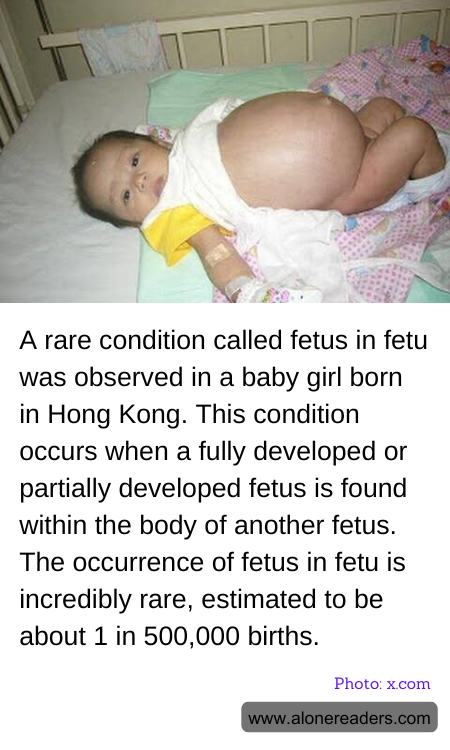
In a remarkable and rare medical occurrence, a baby girl born in Hong Kong was found to have a condition known as fetus in fetu. This phenomenon, which is estimated to occur in approximately 1 in 500,000 births, involves a fully or partially developed fetus being discovered within the body of another fetus. The condition has intrigued medical professionals and the public alike due to its rarity and the complex biological processes that lead to its development.
Fetus in fetu is a condition that has puzzled scientists and doctors for decades. It is believed to result from the incomplete separation of twin embryos during the early stages of pregnancy. As a result, one of the embryos becomes enveloped by the other, leading to the development of a parasitic twin within the host twin's body. This encapsulated twin can vary greatly in its level of development, sometimes possessing recognizable body parts such as limbs or organs, while in other cases, it may be less distinguishable.
The discovery of fetus in fetu often occurs shortly after birth or during infancy, typically when a mass is detected in the abdomen of the host child. In the case of the baby girl from Hong Kong, medical professionals identified the condition during routine examinations. The presence of the parasitic twin can sometimes lead to health complications for the host child, including discomfort, nutritional deficiencies, or pressure on internal organs, necessitating surgical intervention to remove the mass.
Despite its rarity, fetus in fetu has been documented in medical literature for centuries, with cases reported across various cultures and regions. Each instance provides valuable insights into embryonic development and the complexities of human biology. The condition also raises intriguing questions about the nature of twinning and the delicate processes that govern fetal development.
For the families affected by fetus in fetu, the condition can be both a source of concern and fascination. While the medical implications are paramount, the uniqueness of the situation often draws attention and curiosity. Advances in medical imaging and surgical techniques have improved the ability to diagnose and treat fetus in fetu, ensuring better outcomes for affected children.
The case of the baby girl in Hong Kong serves as a reminder of the extraordinary diversity of human development and the mysteries that still exist within the field of medicine. As researchers continue to study such rare conditions, each discovery contributes to a deeper understanding of the human body and the intricate dance of life that begins long before birth.
