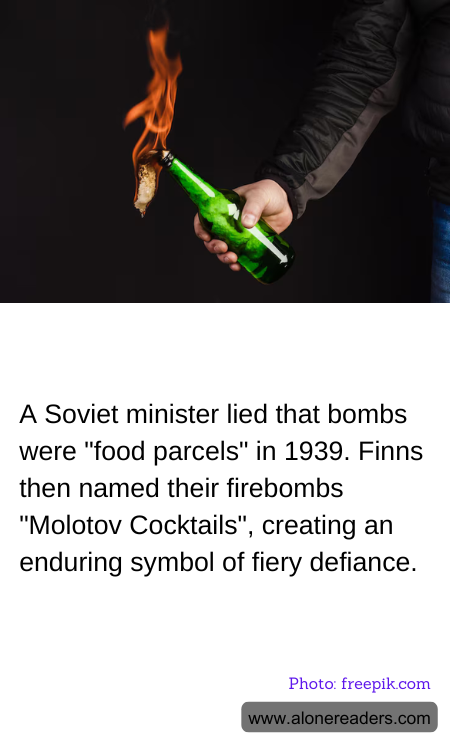
In the annals of history, certain moments stand out not only for their immediate impact but also for the enduring symbols they create. One such moment occurred during the Winter War of 1939-1940, when a Soviet minister's attempt at deception inadvertently gave rise to a symbol of resistance that would endure for decades: the Molotov Cocktail.
The Winter War began when the Soviet Union invaded Finland in November 1939, seeking to expand its territory and secure a buffer zone against Nazi Germany. As Soviet bombers rained destruction upon Finnish cities, the Soviet foreign minister, Vyacheslav Molotov, made a bold and disingenuous claim. He announced that the bombs being dropped were not weapons of war but rather "food parcels" intended to aid the starving Finnish populace. This blatant falsehood was met with derision and disbelief by the Finns, who were well aware of the true nature of the Soviet assault.
In a display of wit and defiance, the Finnish people decided to turn Molotov's lie on its head. They began crafting makeshift incendiary devices using bottles filled with flammable liquids, such as gasoline or alcohol, and a rag as a fuse. These improvised weapons were designed to be thrown at Soviet tanks and other military targets, igniting upon impact and causing significant damage. In a nod to Molotov's infamous statement, the Finns dubbed these firebombs "Molotov Cocktails," suggesting they were a suitable drink to accompany the Soviet "food parcels."
The Molotov Cocktail quickly became a symbol of Finnish resistance and ingenuity. Despite being vastly outnumbered and outgunned, the Finnish forces used these simple yet effective weapons to great effect, slowing the Soviet advance and inflicting considerable losses. The name "Molotov Cocktail" soon spread beyond Finland, becoming synonymous with guerrilla warfare and the spirit of defiance against oppressive forces.
Over time, the Molotov Cocktail has transcended its origins in the Winter War to become a global symbol of resistance. It has been used by various groups and movements around the world, from anti-colonial fighters to modern-day protestors, as a tool of defiance against perceived injustice and tyranny. The simplicity and accessibility of the Molotov Cocktail make it a potent symbol of the power of the oppressed to fight back, even when faced with overwhelming odds.
The story of the Molotov Cocktail is a testament to the resilience and creativity of the human spirit in the face of adversity. It serves as a reminder that even in the darkest of times, a clever twist of language and a simple act of defiance can create a lasting legacy. As long as there are those who seek to oppress and deceive, there will be those who respond with fiery determination and a refusal to be silenced.
