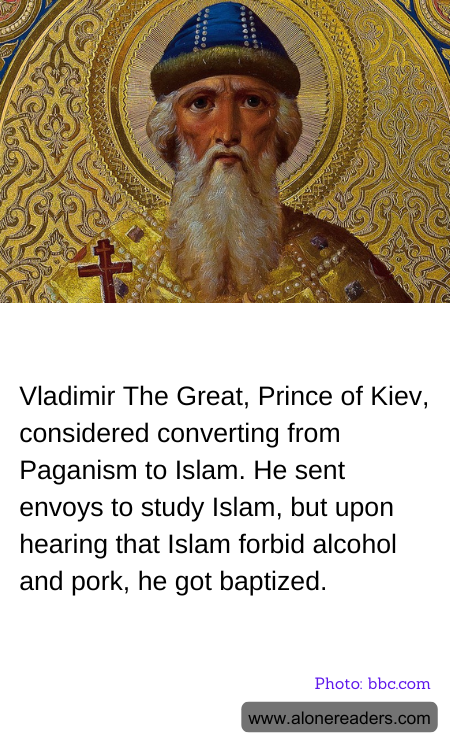
In the annals of history, the tale of Vladimir the Great, the Grand Prince of Kiev, stands out as a pivotal moment in the religious and cultural transformation of Eastern Europe. Born in 958, Vladimir ascended to the throne of Kievan Rus' in 980, inheriting a realm steeped in pagan traditions. However, his reign would be marked by a profound shift towards Christianity, a decision that would shape the spiritual landscape of the region for centuries to come.
Vladimir's journey towards Christianity was not a straightforward one. Initially, he was a staunch adherent of paganism, presiding over a pantheon of Slavic gods. Yet, as a ruler with a vision for unifying and strengthening his realm, Vladimir recognized the potential benefits of adopting a monotheistic religion. This realization set him on a quest to explore the major religions of the time, including Islam, Judaism, and Christianity.
Intrigued by the prospect of Islam, Vladimir dispatched envoys to study the religion more closely. The envoys traveled to the lands of the Volga Bulgars, where they observed Islamic practices and customs. Upon their return, they reported back to Vladimir, detailing the tenets of Islam. While the religion's emphasis on discipline and devotion impressed him, one particular aspect proved to be a stumbling block: the prohibition of alcohol and pork. Known for his fondness for feasting and revelry, Vladimir famously remarked, "Drinking is the joy of the Rus'. We cannot exist without that pleasure."
This pivotal moment led Vladimir to turn his attention towards Christianity. He sent emissaries to the Byzantine Empire, where they witnessed the grandeur of the Orthodox Christian faith in Constantinople. The envoys were particularly captivated by the beauty of the Hagia Sophia and the solemnity of the liturgical ceremonies. Their accounts of the experience painted a picture of a religion that was not only spiritually fulfilling but also culturally enriching.
In 988, Vladimir made the momentous decision to embrace Christianity, opting for baptism in the Byzantine tradition. This act was not merely a personal conversion but a strategic move to forge stronger ties with the Byzantine Empire, a powerful ally. The mass baptism of his subjects in the Dnieper River followed, marking the official Christianization of Kievan Rus'.
Vladimir's conversion to Christianity had far-reaching implications. It facilitated the cultural and political integration of Kievan Rus' into the broader Christian world, fostering connections with other Christian states. The adoption of Christianity also led to the development of a written language, the Cyrillic script, which played a crucial role in the cultural and intellectual growth of the region.
Today, Vladimir the Great is revered as a saint in the Eastern Orthodox Church, celebrated for his role in bringing Christianity to the Slavic peoples. His decision to reject Islam in favor of Christianity, influenced by the simple pleasures of life, underscores the complex interplay of personal preference, political strategy, and cultural transformation that defined his reign.
