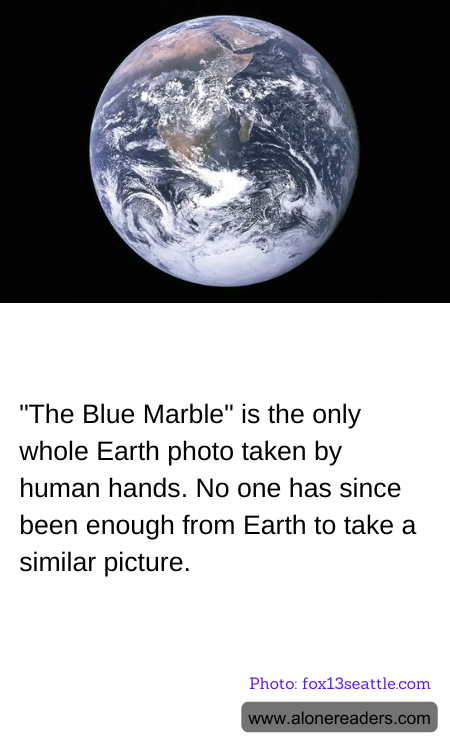
On December 7, 1972, the crew of Apollo 17 captured one of the most iconic images in human history—"The Blue Marble." This photograph, taken from a distance of about 29,000 kilometers (18,000 miles) from Earth, is the only whole Earth photo taken by human hands. It presents our planet as a solitary, vibrant sphere floating in the vastness of space, a perspective that has since become emblematic of Earth's beauty and fragility.
The photograph was taken during the last manned mission to the Moon, and it holds a unique place in the annals of space exploration. The image shows the Earth fully illuminated by the Sun, with Africa, the Arabian Peninsula, and the vast expanse of the Indian Ocean clearly visible. The swirling clouds and deep blue oceans contrast with the rich, earthy tones of the continents, creating a visual representation of the planet that is both breathtaking and humbling.
Since the Apollo 17 mission, no human has traveled far enough from Earth to capture a similar image. While satellites and space probes have provided us with numerous images of Earth, none have been taken by a human hand from such a distance. This fact adds a layer of poignancy to "The Blue Marble," as it remains a singular testament to human exploration and the unique vantage point that only space travel can provide.
The impact of "The Blue Marble" extends beyond its aesthetic appeal. It has played a significant role in shaping our understanding of Earth as a singular, interconnected ecosystem. The image has been used to promote environmental awareness and has become a symbol for global unity and the need to protect our planet. It reminds us that despite our differences, we all share this one home, and its well-being is intrinsically linked to our own.
In the decades since the photograph was taken, technological advancements have allowed us to explore the universe in ways that were once unimaginable. Yet, "The Blue Marble" remains unmatched in its ability to convey the wonder and vulnerability of our planet. It serves as a powerful reminder of the achievements of the Apollo program and the enduring human spirit of exploration.
As we look to the future, with plans for new lunar missions and the possibility of human travel to Mars, "The Blue Marble" continues to inspire. It challenges us to consider our place in the universe and the legacy we wish to leave for future generations. In a world that often feels divided, this singular image of our planet, captured by human hands, calls us to unity and stewardship of the Earth.
