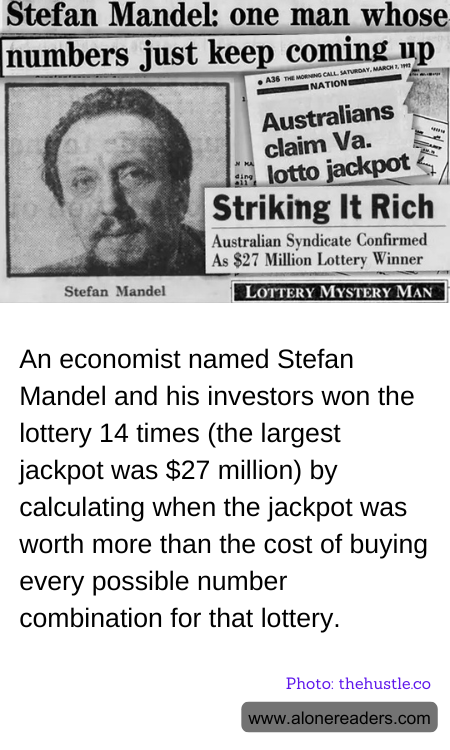
In the world of lotteries, where luck is often deemed the sole determinant of success, the story of Stefan Mandel stands out as a testament to the power of mathematics and strategic thinking. An economist by training, Mandel, along with his team of investors, managed to win the lottery an astonishing 14 times. His most notable victory was a $27 million jackpot, achieved not by chance, but through a meticulously calculated approach.
Mandel's journey into the world of lotteries began in Romania during the 1960s. Faced with economic hardships, he devised a method that would later become legendary. His strategy was based on a simple yet profound realization: if the jackpot was larger than the cost of purchasing every possible number combination, the odds could be tilted in his favor. This insight laid the foundation for a systematic approach to winning lotteries.
The process was both complex and audacious. Mandel's method involved calculating the total number of possible combinations in a lottery draw. Once he identified a lottery where the jackpot exceeded the cost of buying all possible tickets, he and his investors would purchase every combination. This guaranteed a win, provided the logistics of buying and managing such a vast number of tickets could be handled efficiently.
Executing this plan required not only mathematical acumen but also significant organizational skills. Mandel assembled a network of investors who pooled their resources to fund the ticket purchases. This collaborative effort was crucial, as it allowed them to cover the substantial upfront costs involved. The team also had to navigate the logistical challenges of acquiring and managing millions of lottery tickets, a task that required precision and coordination.
Mandel's strategy was not without its risks and challenges. The sheer scale of the operation meant that any miscalculation or logistical error could result in significant financial losses. Moreover, the legal landscape surrounding lotteries was complex, and Mandel had to ensure that his activities remained within the bounds of the law. Despite these hurdles, his method proved remarkably successful, culminating in multiple lottery wins across different countries.
The story of Stefan Mandel is a fascinating intersection of mathematics, strategy, and audacity. It challenges the conventional perception of lotteries as games of pure chance and highlights the potential of analytical thinking to unlock opportunities in unexpected places. While Mandel's approach is not easily replicable, given the changes in lottery regulations and the logistical complexities involved, it remains a compelling example of how innovation and collaboration can turn the odds in one's favor.
For those intrigued by the allure of lotteries, Mandel's story serves as both an inspiration and a cautionary tale. It underscores the importance of strategic planning and the potential rewards of thinking outside the box. However, it also reminds us of the inherent risks and challenges involved in such endeavors. Ultimately, Stefan Mandel's legacy is a testament to the power of human ingenuity and the enduring appeal of the quest for fortune.
