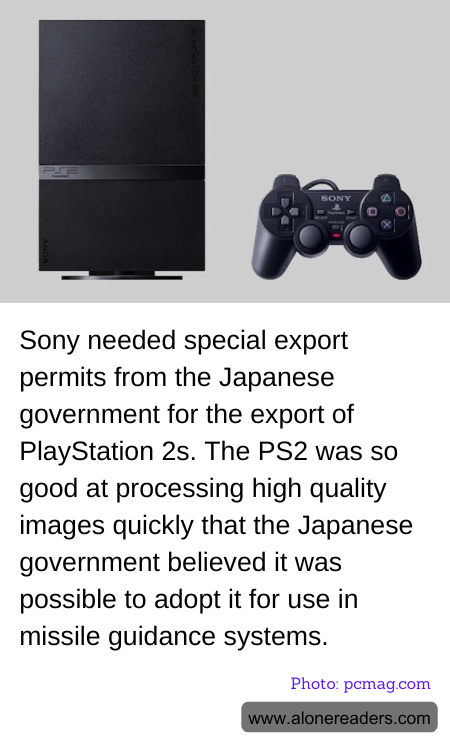
In the early 2000s, the gaming world was abuzz with the release of Sony's PlayStation 2, a console that would go on to become one of the best-selling gaming systems of all time. However, beyond its groundbreaking impact on the gaming industry, the PlayStation 2 was also at the center of an unexpected geopolitical issue. The console's advanced technology was so sophisticated that it caught the attention of the Japanese government, which required Sony to obtain special export permits for its distribution.
The PlayStation 2's central processing unit (CPU) was a marvel of its time. It was capable of rendering high-quality images at speeds that were unprecedented for a consumer product. This capability was not just a boon for gamers who enjoyed more realistic graphics and smoother gameplay; it also raised concerns among government officials. The Japanese government, recognizing the potential dual-use nature of this technology, feared that the PS2's processing power could be repurposed for military applications, specifically in missile guidance systems.
The concern was not entirely unfounded. The PS2's Emotion Engine, developed in collaboration with Toshiba, was a powerful piece of technology that could theoretically be adapted for use in precision targeting systems. This led to the classification of the PlayStation 2 as a "supercomputer" under Japanese export regulations. As a result, Sony was required to secure special export licenses to ship the console to certain countries, particularly those with strained diplomatic relations or those under arms embargoes.
This situation highlights the often-overlooked intersection between consumer technology and national security. While the PlayStation 2 was primarily designed for entertainment, its advanced capabilities inadvertently placed it within the realm of strategic technology. This dual-use dilemma is not unique to the PS2; it is a recurring theme in the tech industry, where innovations intended for civilian use can also have military applications.
Despite these initial hurdles, the PlayStation 2 went on to achieve monumental success, selling over 155 million units worldwide. Its legacy is not only defined by its impact on gaming culture but also by the unique challenges it posed to international trade and security policies. The story of the PS2 serves as a reminder of the complex relationship between technological advancement and global security, illustrating how innovations in one field can ripple across multiple domains.
In conclusion, the PlayStation 2's journey from a gaming console to a subject of international scrutiny underscores the far-reaching implications of technological progress. It is a testament to the power of innovation and a cautionary tale about the responsibilities that come with it. As technology continues to evolve, the lessons learned from the PS2 era remain relevant, reminding us to consider the broader impacts of our technological creations.
