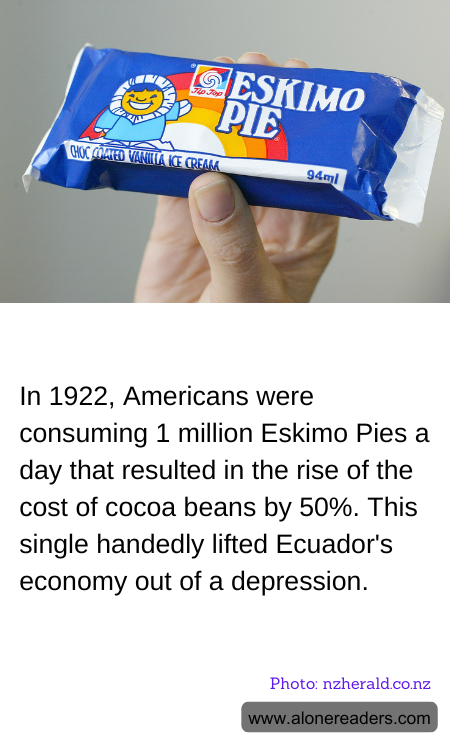
In the early 1920s, a sweet sensation swept across America, captivating the taste buds of millions and inadvertently reshaping the economic landscape of a nation far to the south. The Eskimo Pie, a chocolate-covered ice cream bar, became a cultural phenomenon in 1922, with Americans consuming an astonishing one million of these treats each day. This surge in demand had a ripple effect that extended beyond the borders of the United States, significantly impacting the global cocoa market and providing an unexpected boon to Ecuador's struggling economy.
The Eskimo Pie was the brainchild of Christian Kent Nelson, a schoolteacher from Iowa, who partnered with chocolate manufacturer Russell Stover to bring his creation to the masses. The treat's popularity soared, driven by its novel combination of creamy ice cream encased in a crisp chocolate shell. As the demand for Eskimo Pies skyrocketed, so too did the need for cocoa beans, the primary ingredient in chocolate. This surge in demand led to a dramatic 50% increase in the price of cocoa beans, a commodity that was crucial to the economies of several countries, including Ecuador.
At the time, Ecuador was grappling with a severe economic depression. The country had long been a significant producer of cocoa, often referred to as "black gold" due to its economic importance. The sudden spike in cocoa prices provided a much-needed lifeline for Ecuadorian farmers and the national economy. As cocoa exports became more lucrative, the increased revenue helped stabilize the country's financial situation, lifting it out of the economic doldrums.
The impact of the Eskimo Pie phenomenon on Ecuador's economy serves as a fascinating example of how consumer trends in one part of the world can have far-reaching effects on another. The increased demand for cocoa not only benefited Ecuadorian farmers but also encouraged investment in the country's agricultural sector, leading to improvements in infrastructure and farming techniques. This, in turn, helped to sustain the economic recovery and set the stage for future growth.
The story of the Eskimo Pie and its unintended economic consequences is a testament to the interconnectedness of global markets. It highlights how a simple innovation in one industry can create a cascade of effects that reverberate across continents, influencing economies and livelihoods in unexpected ways. For Ecuador, the chocolate-covered ice cream bar was more than just a popular dessert; it was a catalyst for economic revival, demonstrating the power of consumer demand to drive change on a global scale.
