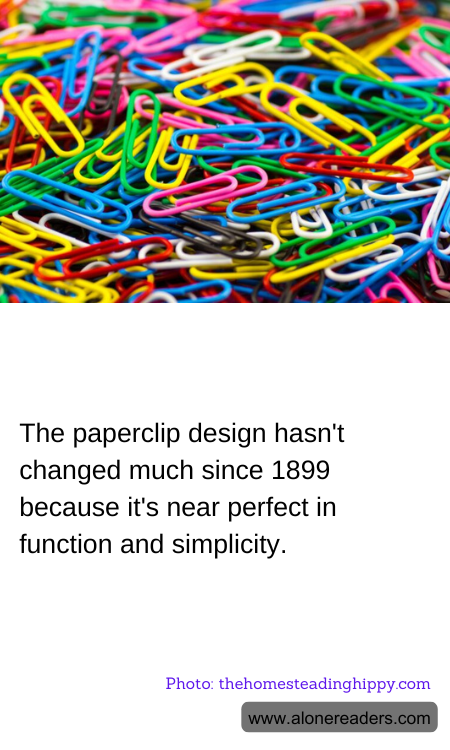
In a world where technology and design are constantly evolving, it's fascinating to consider the humble paperclip, a small yet indispensable tool that has remained largely unchanged since its inception in 1899. The paperclip's enduring design is a testament to its near-perfect function and simplicity, making it a staple in offices, schools, and homes around the globe.
The paperclip as we know it today was patented by Johan Vaaler, a Norwegian inventor, at the turn of the 20th century. While there were earlier versions of wire fasteners, Vaaler's design captured the essence of what makes a paperclip so effective: a simple loop of wire that can hold sheets of paper together without causing damage. This design is not only efficient but also elegant in its minimalism, embodying the principle that sometimes less is more.
One of the key reasons the paperclip has stood the test of time is its versatility. Despite its primary function of holding papers together, it has been used in countless other ways. From makeshift zipper pulls to emergency SIM card ejectors, the paperclip's utility extends far beyond its original purpose. Its ability to adapt to various needs without any modification is a hallmark of great design.
Moreover, the paperclip's simplicity is its strength. It requires no additional parts or complex mechanisms to function. This simplicity ensures that it is both cost-effective to produce and easy to use. The paperclip's design is intuitive, requiring no instructions or learning curve, which makes it accessible to people of all ages and backgrounds. Its ubiquity is a testament to its universal appeal and practicality.
The paperclip also serves as a symbol of ingenuity and resourcefulness. During World War II, Norwegian patriots wore paperclips on their lapels as a subtle sign of resistance against Nazi occupation, as the clips symbolized unity and solidarity. This historical anecdote highlights how a simple object can carry profound meaning and serve as a tool for expression.
In an era where innovation often means adding more features or complexity, the paperclip reminds us of the beauty and efficiency of simplicity. Its design has remained largely unchanged for over a century because it fulfills its purpose with grace and effectiveness. As we continue to seek out new solutions and technologies, the paperclip stands as a quiet reminder that sometimes the best designs are those that are straightforward and unassuming.
In conclusion, the paperclip's enduring design is a marvel of functionality and simplicity. Its ability to perform its intended task with minimal fuss and maximum efficiency has ensured its place in our daily lives for over a hundred years. As we look to the future, the paperclip will likely continue to hold its ground as a symbol of perfect design, proving that sometimes the simplest solutions are the most enduring.
