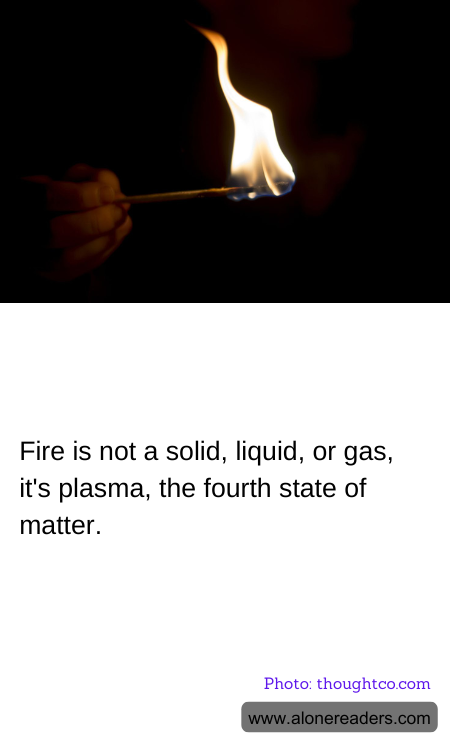
Fire is a phenomenon that has fascinated humans for millennia, serving as a source of warmth, light, and even inspiration. While many people might categorize fire as a solid, liquid, or gas, it is, in fact, none of these. Fire is actually plasma, the fourth state of matter, which is a concept that might surprise those who are more familiar with the traditional three states.
To understand why fire is plasma, it's important to first grasp what plasma is. Plasma is a state of matter where gas is energized to the point that some of its electrons break free from their atoms, resulting in a collection of charged particles: ions and free electrons. This state is distinct from solids, liquids, and gases due to its unique properties, such as being electrically conductive and responsive to magnetic fields. Plasma is often referred to as an "ionized gas," but it behaves differently from a typical gas due to these charged particles.
When a material combusts, it undergoes a chemical reaction that releases energy in the form of heat and light. This energy is sufficient to ionize the gases produced by the combustion process, creating plasma. The bright, flickering light we see in a flame is the result of this ionization. The electrons in the plasma emit light as they recombine with ions, producing the characteristic glow of fire. This is why fire can be considered a form of plasma rather than a simple gas.
Fire's classification as plasma helps explain some of its unique behaviors. For instance, the way flames flicker and dance is partly due to the interactions of the charged particles within the plasma. Additionally, the temperature of a flame can vary significantly, with the hottest part often being the blue or white core, where ionization is most intense. This understanding of fire as plasma also sheds light on why flames can be influenced by magnetic fields, a property not shared by ordinary gases.
Recognizing fire as plasma not only enriches our understanding of this everyday phenomenon but also connects it to a broader scientific context. Plasma is not just found in flames; it is the most common state of matter in the universe, present in stars, including our sun, and in the vast stretches of space between them. By viewing fire through the lens of plasma physics, we gain a deeper appreciation for the complexity and beauty of this elemental force.
In conclusion, fire is much more than a simple chemical reaction; it is a manifestation of plasma, the fourth state of matter. This realization enhances our understanding of fire's properties and behaviors, linking it to the vast, plasma-filled universe beyond our immediate experience. Whether warming our homes or lighting our way, fire remains a captivating and essential part of human life, now with an added layer of scientific intrigue.
