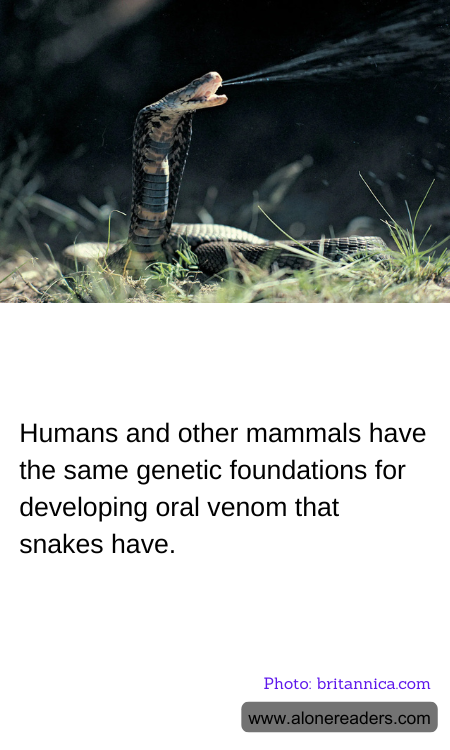
The idea that humans and other mammals share the genetic foundations for developing oral venom, akin to that of snakes, is a fascinating revelation that has intrigued scientists and the general public alike. This discovery challenges our traditional understanding of venom and its evolutionary pathways, suggesting that the potential for venom production is more widespread across the animal kingdom than previously thought.
Venom is a complex cocktail of proteins and enzymes that some animals use for defense, predation, or competition. While snakes are the most well-known venomous creatures, the ability to produce venom is not exclusive to them. Recent studies have shown that the genetic toolkit required for venom production is present in a variety of animals, including mammals. This genetic toolkit comprises genes that encode for proteins similar to those found in snake venom, indicating a shared evolutionary origin.
In mammals, the presence of these genes does not necessarily mean that they produce venom in the same way snakes do. Instead, these genes may be involved in other physiological processes. For example, some mammals, like certain species of shrews and the platypus, do produce venom, albeit in a different form and for different purposes than snakes. The platypus, for instance, uses venom as a defense mechanism, delivered through spurs on its hind legs. This suggests that the genetic potential for venom production in mammals may have been repurposed over time for various functions.
The discovery of these genetic foundations in humans and other mammals opens up intriguing possibilities for scientific research. Understanding the evolutionary history and function of these genes could provide insights into the development of new medical treatments. Venom has long been studied for its potential therapeutic applications, and the proteins involved in venom production could lead to breakthroughs in pain management, blood pressure regulation, and even cancer treatment.
Moreover, this finding highlights the interconnectedness of life on Earth, emphasizing the shared genetic heritage that links diverse species. It serves as a reminder of the complexity and adaptability of evolutionary processes, where similar genetic tools can be utilized in different ways across the animal kingdom.
In conclusion, the shared genetic foundations for venom production in humans and other mammals underscore the remarkable versatility of evolution. While we may not be developing venomous bites anytime soon, the presence of these genes in our DNA is a testament to the intricate tapestry of life and the endless possibilities it holds for scientific discovery and innovation. As research continues, we may uncover even more surprising connections that deepen our understanding of the natural world and our place within it.
