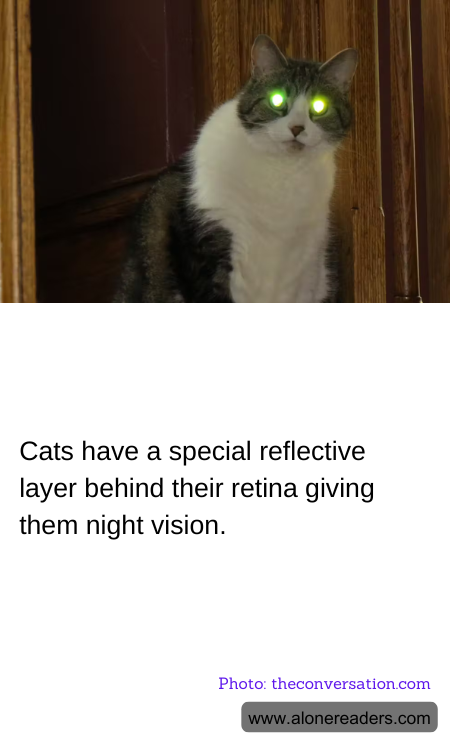
Cats have long been admired for their mysterious and graceful nature, often captivating humans with their ability to navigate the darkest of environments with ease. One of the most fascinating aspects of a cat's anatomy that contributes to this remarkable ability is the presence of a special reflective layer behind their retina, known as the tapetum lucidum. This unique feature is a key factor in granting cats their extraordinary night vision, allowing them to thrive in low-light conditions where other animals might struggle.
The tapetum lucidum is a layer of tissue located behind the retina, which acts like a mirror. When light enters a cat's eye, it passes through the retina and hits the tapetum lucidum. This reflective layer then bounces the light back through the retina, giving the photoreceptor cells a second chance to absorb it. This process significantly enhances a cat's ability to see in the dark, as it maximizes the amount of light available for vision. This adaptation is particularly useful for nocturnal hunters like cats, who rely on their keen eyesight to track and capture prey during the night.
In addition to the tapetum lucidum, cats also possess a higher number of rod cells in their retinas compared to humans. Rod cells are responsible for detecting light and motion, and their abundance in a cat's eye further enhances their ability to see in dim lighting. While humans have more cone cells, which are responsible for color vision, cats have evolved to prioritize their night vision capabilities, making them adept at detecting movement and shapes in the dark.
The presence of the tapetum lucidum is not unique to cats; it is also found in many other animals, including dogs, deer, and raccoons. However, the efficiency and effectiveness of this reflective layer can vary among species. In cats, the tapetum lucidum is particularly well-developed, contributing to their reputation as stealthy and efficient nocturnal predators.
For cat owners, understanding this aspect of feline biology can enhance the appreciation of their pets' abilities. It explains why cats often seem more active and alert during the night and why their eyes may appear to glow eerily in the dark when caught in a beam of light. This glow is a result of the light reflecting off the tapetum lucidum, a phenomenon that adds to the mystique of these beloved animals.
In conclusion, the tapetum lucidum is a remarkable adaptation that allows cats to see in near darkness, making them exceptional hunters and companions. This reflective layer, combined with their abundance of rod cells, ensures that cats can navigate their environment with precision and grace, even when the lights go out. Whether stalking prey in the wild or simply exploring a dimly lit room at home, cats continue to captivate us with their extraordinary night vision and enigmatic charm.
