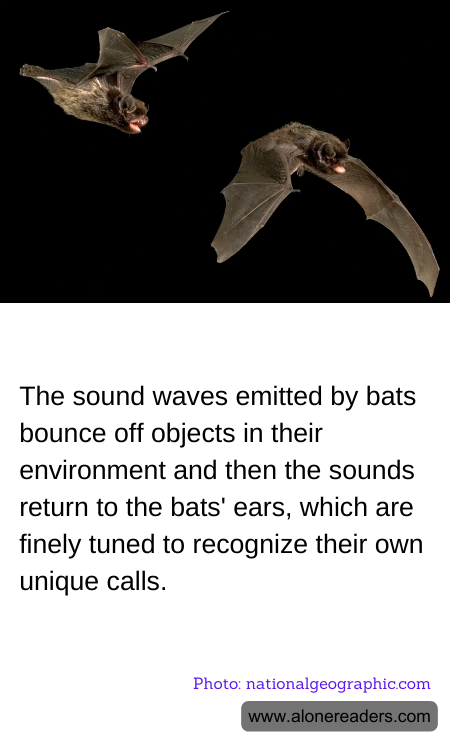
Bats are fascinating creatures that have intrigued scientists and nature enthusiasts alike for centuries. One of their most remarkable abilities is echolocation, a sophisticated biological sonar system that allows them to navigate and hunt in complete darkness. This process involves emitting sound waves that bounce off objects in their environment, with the returning echoes providing crucial information about the surroundings.
The mechanism of echolocation is both simple and complex. Bats produce high-frequency sound waves, often beyond the range of human hearing, through their larynx. These sound waves travel through the air and, upon hitting an object, reflect back towards the bat. The returning echoes are captured by the bat's highly sensitive ears, which are finely tuned to recognize their own unique calls amidst the cacophony of the natural world.
Each bat species has its own distinct call, which helps them avoid confusion with the calls of other bats. This specificity is crucial, especially in environments where multiple bat species coexist. The ability to distinguish their own echoes allows bats to accurately determine the size, shape, distance, and even texture of objects, enabling them to identify prey, avoid obstacles, and navigate through their habitat with remarkable precision.
The intricacy of this system is astounding. Bats can adjust the frequency and intensity of their calls depending on their immediate needs. For instance, when closing in on prey, they may increase the frequency of their calls to gather more detailed information. This adaptability showcases the evolutionary marvel of echolocation, which has allowed bats to thrive in diverse environments across the globe.
Moreover, the study of bat echolocation has inspired technological advancements in human society. Sonar and radar systems, used in various fields such as aviation and marine navigation, have been developed by mimicking the principles of echolocation. This is a testament to the efficiency and effectiveness of the natural world, offering solutions to complex human challenges.
In conclusion, the sound waves emitted by bats and their ability to interpret the returning echoes is a testament to the wonders of evolution. This natural sonar system not only ensures their survival but also enriches our understanding of the natural world. As we continue to study these remarkable creatures, we gain insights that extend beyond biology, influencing technology and inspiring innovation. Bats, with their unique echolocation abilities, remind us of the intricate connections between nature and human ingenuity.
