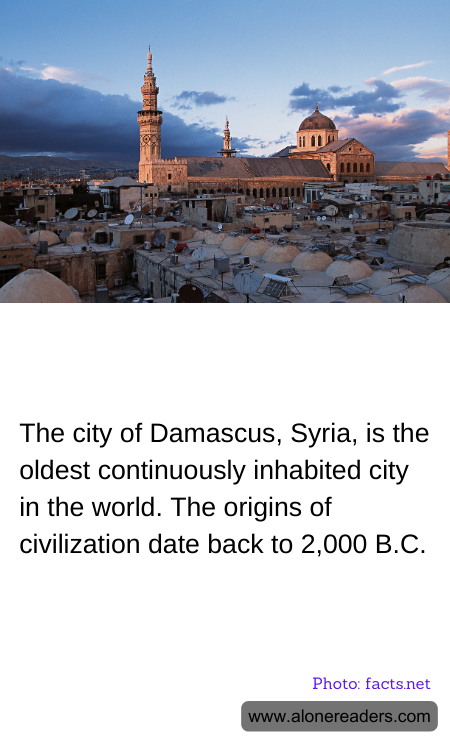
Nestled in the heart of the Middle East, Damascus, the capital of Syria, stands as a testament to human endurance and cultural evolution. Known as the oldest continuously inhabited city in the world, Damascus offers a unique glimpse into the origins of civilization, with its history stretching back to 2,000 B.C. This ancient city has witnessed the rise and fall of empires, the birth of religions, and the evolution of human society, making it a living museum of human history.
The origins of Damascus are shrouded in the mists of time, with archaeological evidence suggesting that the area was first settled around 2,000 B.C. Over the millennia, it has been a melting pot of cultures and civilizations, including the Arameans, Romans, Byzantines, and Ottomans, each leaving an indelible mark on the city's landscape and culture. The city's strategic location at the crossroads of trade routes between Asia, Africa, and Europe has made it a focal point for commerce and cultural exchange throughout history.
One of the most remarkable features of Damascus is its Old City, a UNESCO World Heritage site, which is a labyrinth of narrow alleys, bustling souks, and ancient buildings. The Umayyad Mosque, one of the largest and oldest mosques in the world, stands as a symbol of the city's Islamic heritage. Built on the site of a Christian basilica, which itself was constructed over a Roman temple, the mosque exemplifies the layers of history that define Damascus. The city's architecture reflects a blend of styles, from Roman arches to Islamic minarets, showcasing the diverse influences that have shaped its identity.
Damascus is not just a relic of the past; it is a vibrant city where ancient traditions coexist with modern life. The city's souks are alive with the sounds of merchants selling spices, textiles, and handicrafts, offering a sensory experience that transports visitors back in time. The local cuisine, rich with flavors and aromas, is a testament to the city's diverse cultural heritage, with dishes that have been passed down through generations.
Despite the challenges it has faced in recent years, including the ongoing conflict in Syria, Damascus remains a symbol of resilience and continuity. Its people, known for their hospitality and warmth, continue to preserve their rich cultural heritage while adapting to the demands of the modern world. The city's ability to endure and thrive amidst adversity is a testament to the enduring spirit of its inhabitants.
In conclusion, Damascus is more than just a city; it is a living chronicle of human civilization. Its ancient streets and monuments tell the story of humanity's journey through time, offering invaluable insights into our shared past. For those who visit, Damascus provides an opportunity to walk in the footsteps of history, to experience the confluence of cultures, and to witness the enduring legacy of one of the world's oldest cities.
