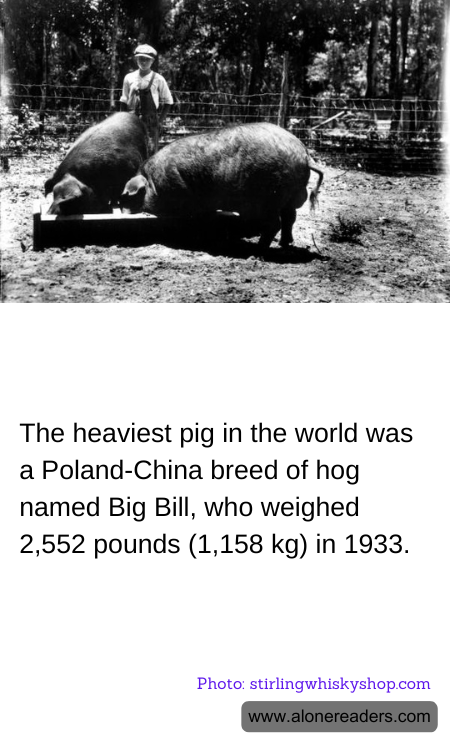
In the annals of agricultural history, few animals have captured the imagination quite like Big Bill, the heaviest pig ever recorded. This remarkable Poland-China breed hog tipped the scales at an astonishing 2,552 pounds (1,158 kg) in 1933, a weight that remains unmatched to this day. Big Bill's story is not just one of size but also a testament to the unique characteristics of the Poland-China breed and the era in which he lived.
Originating in the United States, the Poland-China breed is renowned for its excellent meat quality and substantial size. Developed in the early 19th century in Ohio, this breed is a cross between several European breeds, including the Berkshire and Hampshire. The result was a pig that not only grew large but also thrived in the American agricultural landscape. Big Bill was a prime example of the breed's potential, reaching a size that was both awe-inspiring and unprecedented.
Big Bill's life was a reflection of the agricultural practices of the early 20th century, a time when farming was undergoing significant changes. The Great Depression had gripped the world, and farmers were seeking ways to maximize their yields and profits. In this context, a pig of Big Bill's size was not just a curiosity but a potential boon. His massive size would have provided a substantial amount of meat, a valuable commodity during a time of economic hardship.
Despite his size, Big Bill was more than just a source of meat. He became a local celebrity, drawing attention from far and wide. People were fascinated by his sheer size and the novelty of such a large animal. His fame was a testament to the human fascination with records and extremes, a fascination that continues to this day with various record-breaking animals and feats.
Big Bill's legacy lives on as a symbol of agricultural achievement and the potential of selective breeding. While modern farming practices have shifted towards more sustainable and ethical methods, the story of Big Bill serves as a reminder of the past and the incredible capabilities of animal husbandry. Today, the Poland-China breed continues to be valued for its meat quality, though none have reached the legendary size of Big Bill.
In a world where records are constantly being broken, Big Bill's record remains unchallenged, a testament to the unique circumstances and genetics that allowed him to grow to such an extraordinary size. His story is a fascinating chapter in the history of agriculture, illustrating the intersection of human ingenuity, animal genetics, and the ever-evolving landscape of farming practices.
