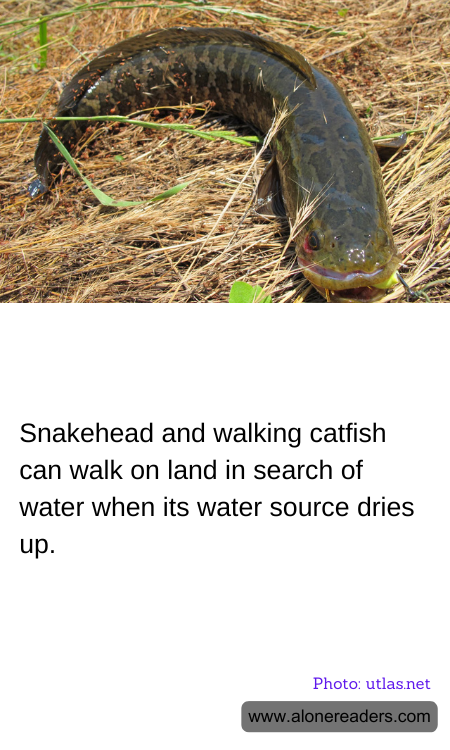
In the fascinating world of aquatic life, certain fish have evolved remarkable adaptations that allow them to survive in challenging environments. Among these extraordinary creatures are the snakehead and the walking catfish, both of which possess the unique ability to traverse land in search of new water sources when their habitats dry up. This remarkable behavior not only highlights their resilience but also underscores the intricate balance of ecosystems where they reside.
The snakehead fish, native to parts of Asia and Africa, is renowned for its ability to breathe air, thanks to a specialized labyrinth organ. This adaptation allows the snakehead to survive out of water for extended periods, enabling it to move across land in search of more hospitable aquatic environments. With a muscular, elongated body, the snakehead can wriggle its way across moist terrain, often traveling significant distances to find a new home. This capability is particularly advantageous in regions where water bodies are prone to drying up, ensuring the snakehead's survival in fluctuating conditions.
Similarly, the walking catfish, native to Southeast Asia, has developed its own set of adaptations for terrestrial movement. Equipped with a modified pectoral fin structure, the walking catfish can "walk" on land by using a combination of fin movements and body undulations. This fish is also capable of breathing atmospheric air, thanks to its labyrinth organ, allowing it to endure periods outside of water. The walking catfish's ability to traverse land has facilitated its spread to various regions, including parts of the United States, where it has become an invasive species.
The terrestrial journeys of these fish are not without challenges. They must navigate a variety of obstacles, from rough terrain to potential predators, all while avoiding desiccation. However, their remarkable adaptations have enabled them to thrive in environments where other fish might perish. This resilience is a testament to the power of evolution and the diverse strategies life employs to persist in the face of adversity.
While the ability of snakeheads and walking catfish to move on land is a marvel of nature, it also poses ecological concerns. In regions where these fish are not native, their presence can disrupt local ecosystems, outcompeting native species for resources and altering the balance of aquatic communities. This has led to efforts to manage and control their populations in non-native areas to protect local biodiversity.
In conclusion, the snakehead and walking catfish exemplify the incredible adaptability of life on Earth. Their ability to walk on land in search of water is a survival strategy that has allowed them to endure in dynamic environments. As we continue to study these fascinating creatures, we gain a deeper appreciation for the complexity of ecosystems and the delicate interplay of species within them. Whether viewed as a marvel or a menace, the terrestrial travels of these fish remind us of the intricate web of life that sustains our planet.
