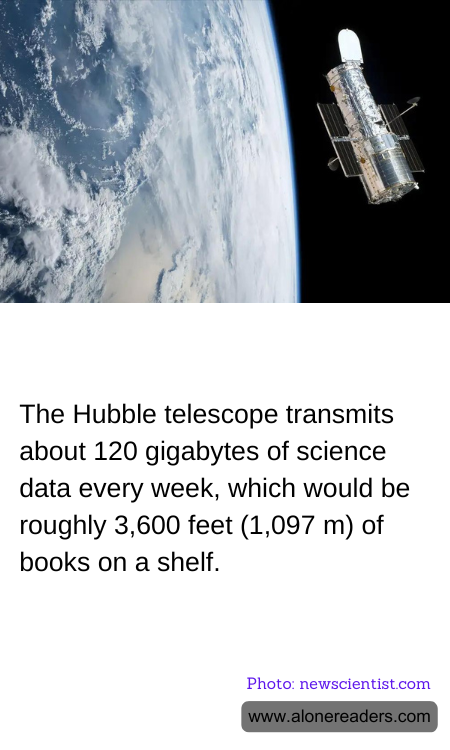
The Hubble Space Telescope, a marvel of modern engineering and a beacon of human curiosity, has been orbiting Earth since 1990, providing us with breathtaking images and invaluable scientific data. One of the most astonishing aspects of this technological wonder is its ability to transmit approximately 120 gigabytes of science data back to Earth every week. To put this into perspective, this amount of data is equivalent to about 3,600 feet, or 1,097 meters, of books lined up on a shelf. This remarkable feat underscores the telescope's pivotal role in expanding our understanding of the universe.
The data collected by Hubble is not just a collection of pretty pictures; it is a treasure trove of information that scientists use to unravel the mysteries of the cosmos. Each byte of data contributes to a greater understanding of phenomena such as the life cycles of stars, the formation of galaxies, and the nature of black holes. The telescope's observations have led to groundbreaking discoveries, including the accelerating expansion of the universe, which has profound implications for our understanding of cosmology.
Hubble's ability to gather such a vast amount of data is a testament to its sophisticated instruments and the dedication of the scientists and engineers who maintain and operate it. The telescope is equipped with a suite of advanced cameras and spectrographs that capture light across a wide range of wavelengths, from ultraviolet to near-infrared. This capability allows Hubble to peer deep into space and time, observing objects that are billions of light-years away.
The process of transmitting this data back to Earth is a complex and carefully orchestrated operation. Once the data is collected, it is stored onboard the telescope until it can be sent to Earth via a network of satellites. From there, it is received by ground stations and processed by teams of scientists who analyze and interpret the information. This collaborative effort ensures that the data is not only preserved but also made accessible to researchers and the public worldwide.
The sheer volume of data transmitted by Hubble each week highlights the telescope's enduring legacy and its continued relevance in the field of astronomy. As we stand on the brink of new discoveries, with upcoming missions like the James Webb Space Telescope poised to join Hubble in the exploration of the universe, we are reminded of the importance of these scientific endeavors. They not only deepen our understanding of the cosmos but also inspire future generations to look up at the stars and wonder about the mysteries that lie beyond our planet.
In essence, the Hubble Space Telescope is more than just a tool for scientific inquiry; it is a symbol of human ingenuity and our relentless pursuit of knowledge. Its ability to transmit such a vast amount of data each week is a testament to the power of technology and the boundless curiosity that drives us to explore the universe. As we continue to learn from Hubble's observations, we are reminded of the infinite possibilities that await us in the cosmos.
