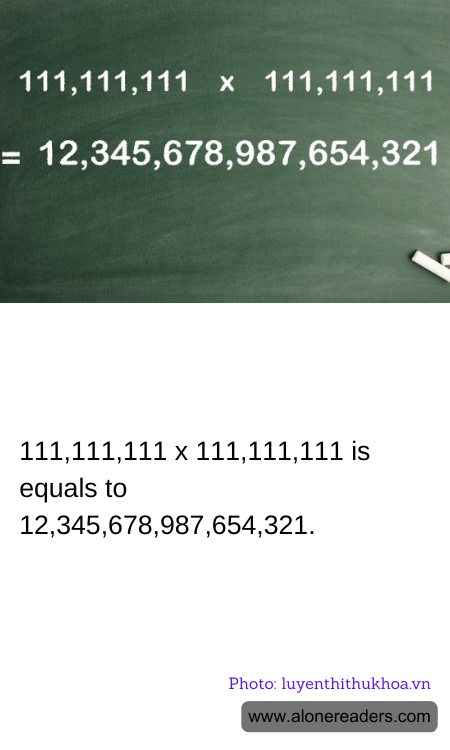
Mathematics often reveals fascinating patterns and surprises that captivate both the curious minds of young learners and the seasoned eyes of experienced mathematicians. One such intriguing example is the multiplication of the number 111,111,111 by itself, which results in the palindromic number 12,345,678,987,654,321. This mathematical curiosity not only showcases the beauty of numbers but also highlights the elegance and symmetry that can be found within arithmetic operations.
The number 111,111,111 is composed entirely of the digit '1' repeated eight times. When this number is multiplied by itself, the result is a 17-digit number that reads the same forwards and backwards. This palindromic nature is what makes the product so remarkable and aesthetically pleasing. The sequence of digits in the result, 12,345,678,987,654,321, follows a pattern that ascends to the middle and then descends symmetrically, creating a mirror image around the central digit.
This phenomenon is not just a coincidence but rather a demonstration of the inherent patterns that exist within the realm of numbers. The multiplication of numbers with repeated digits often leads to interesting results, and in this case, the alignment of digits in the product is a testament to the structured beauty of mathematics. Such patterns can be found in various mathematical operations and are often used to engage students and enthusiasts in exploring the wonders of numbers.
The appeal of this multiplication extends beyond its numerical result. It serves as an excellent example for educators to illustrate the concept of palindromes, symmetry, and the power of multiplication. It can spark curiosity and encourage learners to delve deeper into the study of numbers, exploring other similar patterns and relationships. This example also provides a platform for discussing the properties of numbers and the significance of patterns in mathematics, which are foundational concepts in the subject.
For those who enjoy puzzles and number games, this multiplication offers a delightful challenge. It invites individuals to explore other numbers that might exhibit similar properties or to create their own number patterns. The exploration of such mathematical curiosities can lead to a greater appreciation for the subject and inspire a lifelong interest in the beauty of mathematics.
In conclusion, the multiplication of 111,111,111 by itself resulting in the palindromic number 12,345,678,987,654,321 is a captivating example of the elegance and symmetry found in mathematics. It serves as a reminder of the intricate patterns that numbers can form and the joy that can be found in exploring these patterns. Whether for educational purposes or personal enjoyment, this mathematical curiosity continues to fascinate and inspire people of all ages.
