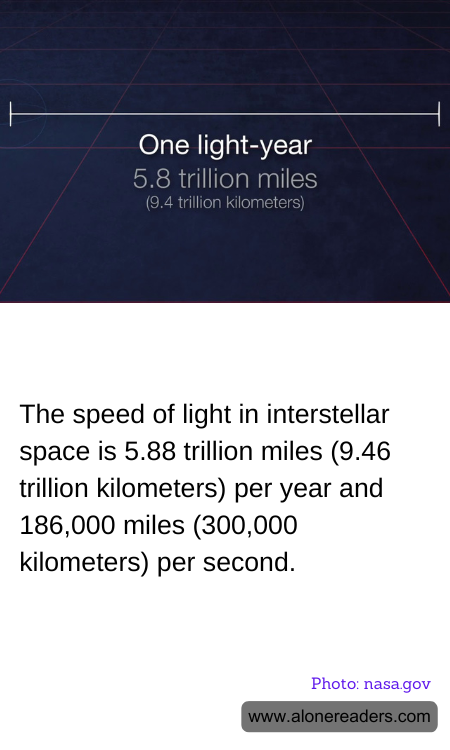
The speed of light is one of the most fascinating constants in the universe, a cornerstone of modern physics that captivates both scientists and curious minds alike. In the vast expanse of interstellar space, light travels at an astonishing speed of 186,000 miles per second, or approximately 300,000 kilometers per second. This incredible velocity translates to about 5.88 trillion miles, or 9.46 trillion kilometers, in a single year—distances that are almost beyond human comprehension.
Understanding the speed of light is crucial for grasping the scale of the universe. Light's rapid journey across the cosmos allows us to see stars and galaxies that are millions or even billions of light-years away. When we observe these distant celestial bodies, we are essentially looking back in time, witnessing the universe as it was when that light first began its journey toward us. This concept, known as "look-back time," provides astronomers with a unique window into the history and evolution of the universe.
The speed of light is not just a measure of distance; it is also a fundamental limit in the universe. According to Einstein's theory of relativity, nothing can travel faster than light in a vacuum. This principle has profound implications for our understanding of space and time, suggesting that as objects approach the speed of light, time itself begins to slow down relative to an outside observer. This phenomenon, known as time dilation, has been confirmed through numerous experiments and is a key component of modern physics.
In practical terms, the speed of light sets the ultimate speed limit for information and communication across the cosmos. While science fiction often imagines faster-than-light travel, such as warp drives or hyperspace jumps, these remain speculative concepts without experimental evidence. For now, the speed of light defines the boundaries of our reach into the universe, shaping our exploration and understanding of the cosmos.
Despite its seemingly insurmountable speed, light's journey across the universe is not instantaneous. For example, light from the Sun takes about eight minutes to reach Earth, while light from the nearest star system, Alpha Centauri, takes over four years to arrive. These distances highlight the vastness of space and the challenges faced by astronomers and space explorers.
In conclusion, the speed of light is a fundamental aspect of our universe, influencing everything from our perception of time and space to the limits of our technological capabilities. As we continue to explore the cosmos, the speed of light remains a guiding constant, a reminder of the vast and wondrous universe that lies beyond our reach. Whether through the lens of a telescope or the pages of a science fiction novel, the speed of light continues to inspire awe and curiosity in people of all ages.
