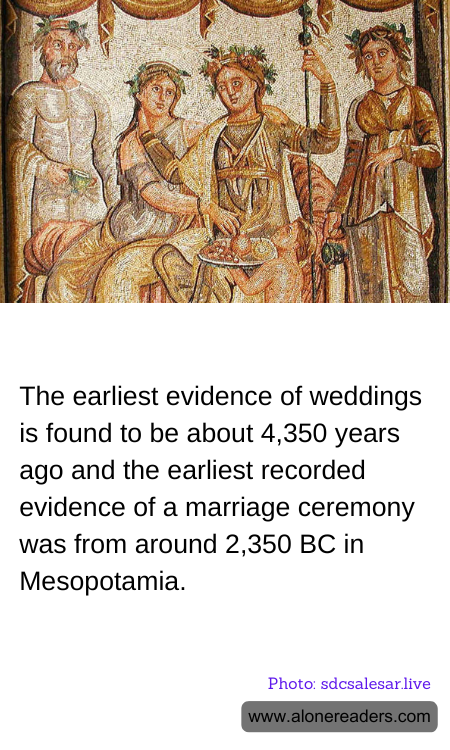
The concept of marriage, a cornerstone of human society, has a history that stretches back thousands of years. Recent archaeological findings suggest that the earliest evidence of weddings dates back approximately 4,350 years. This discovery provides a fascinating glimpse into the social structures of ancient civilizations and highlights the enduring nature of this institution.
The earliest recorded evidence of a marriage ceremony comes from around 2,350 BC in Mesopotamia, a region often referred to as the cradle of civilization. Mesopotamia, located between the Tigris and Euphrates rivers in what is now modern-day Iraq, was home to some of the earliest known human societies. These ancient communities were among the first to develop writing, agriculture, and urbanization, and they also laid the groundwork for many social customs that persist today, including marriage.
In Mesopotamian society, marriage was not just a personal or romantic union but a crucial social contract. It served to establish alliances between families, ensure the continuation of family lines, and provide a stable environment for raising children. The marriage ceremony itself was a formal affair, often involving elaborate rituals and the exchange of gifts. These ceremonies were typically documented on clay tablets, which have provided historians with valuable insights into the customs and traditions of the time.
The significance of marriage in ancient Mesopotamia was reflected in their legal codes, such as the Code of Hammurabi, which included detailed laws governing marriage and family life. These laws addressed issues such as dowries, inheritance, and the rights and responsibilities of spouses, indicating the importance of marriage in maintaining social order and stability.
While the specifics of marriage ceremonies have evolved over millennia, the fundamental purpose of marriage as a social institution has remained remarkably consistent. It continues to serve as a means of uniting individuals and families, fostering community ties, and providing a framework for raising future generations. The discovery of these early wedding records underscores the deep-rooted human desire for connection and continuity.
Today, marriage ceremonies vary widely across cultures and religions, each with its unique traditions and customs. However, the ancient Mesopotamian marriage ceremonies remind us of the shared human heritage that underpins this universal institution. As we continue to uncover more about our past, these ancient practices offer valuable lessons about the enduring nature of human relationships and the societal structures that support them.
In conclusion, the earliest evidence of weddings and marriage ceremonies from ancient Mesopotamia provides a fascinating window into the origins of a practice that remains central to human society. These findings not only enrich our understanding of ancient civilizations but also highlight the timeless nature of marriage as a vital social institution.
