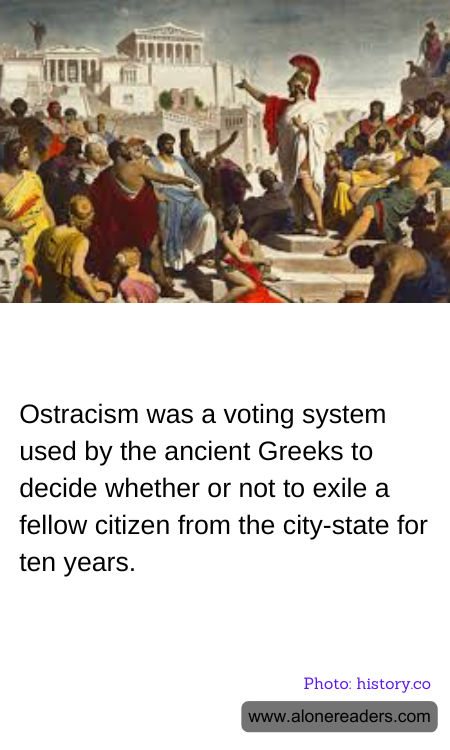
In the vibrant tapestry of ancient Greek civilization, ostracism stood out as a unique political mechanism, reflecting the democratic ethos of the city-state of Athens. This intriguing practice was not merely a tool for banishment but a sophisticated system designed to protect the polis from potential tyranny and internal discord. Originating in the early 5th century BCE, ostracism was a testament to the Athenians' commitment to maintaining a balanced and harmonious society.
Ostracism was a process whereby citizens could vote to exile an individual from the city-state for a period of ten years. This was not a punishment for a crime in the traditional sense, as those ostracized were not stripped of their property or rights. Instead, it was a preemptive measure aimed at neutralizing individuals who were perceived as threats to the democratic order, whether due to their growing power, influence, or controversial actions. The process was deeply rooted in the democratic principles of Athens, allowing the populace to exercise their collective will in safeguarding their community.
The procedure for ostracism was both straightforward and democratic. Each year, the citizens of Athens would gather in the assembly to decide whether an ostracism should be held. If the decision was affirmative, a special assembly would be convened where citizens could inscribe the name of the person they wished to exile on a shard of pottery, known as an ostrakon. For the ostracism to be valid, a quorum of at least 6,000 votes was required. The individual whose name appeared most frequently on these ostraka would be exiled, effectively removing them from the political landscape for a decade.
Despite its seemingly harsh nature, ostracism was not intended to be punitive. Those exiled retained their property and could return to Athens after the ten-year period, often resuming their previous roles in society. This aspect underscores the preventive rather than punitive intent of the practice, focusing on the well-being of the state rather than retribution against the individual. It was a mechanism that allowed Athens to navigate the complexities of power dynamics without resorting to more severe measures.
Ostracism, however, was not without its critics and limitations. The process could be influenced by political maneuvering and personal vendettas, leading to the exile of individuals who may not have posed a genuine threat. Over time, as the political landscape of Athens evolved, the practice fell out of favor and was eventually abandoned. Nonetheless, the concept of ostracism remains a fascinating reflection of the Athenian commitment to democracy and the lengths to which they would go to preserve it.
In modern discourse, the term "ostracism" has transcended its historical roots, often used to describe social exclusion in various contexts. Yet, its origins in ancient Greece offer a compelling glimpse into the complexities of governance and the enduring human struggle to balance individual ambition with collective harmony. Through ostracism, the Athenians demonstrated an early understanding of the delicate interplay between power and democracy, a lesson that continues to resonate in contemporary society.
