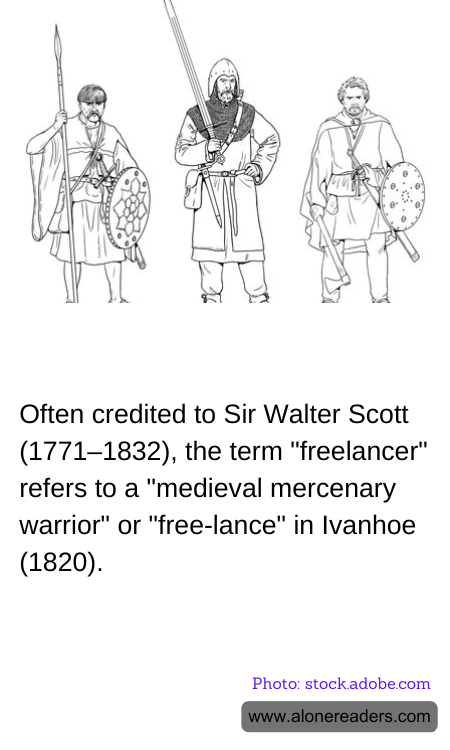
The term "freelancer" is a staple in today's gig economy, representing individuals who work independently, offering their skills and services to various clients without a long-term commitment to any single employer. However, the origins of this term are steeped in history, tracing back to the early 19th century and the literary works of Sir Walter Scott. Often credited to Scott, the term "freelancer" first appeared in his historical novel "Ivanhoe," published in 1820. In this context, it referred to a "medieval mercenary warrior" or "free-lance," a soldier who was not bound by loyalty to any particular lord or kingdom but instead offered his combat services to the highest bidder.
In "Ivanhoe," Scott vividly depicted the tumultuous era of medieval England, a time when knights and warriors roamed the land, often selling their martial prowess to those who could afford them. The term "free-lance" was a literal description of these warriors, whose lances were free from any feudal obligations. This concept of independence and flexibility resonates with the modern understanding of freelancing, where individuals choose projects and clients based on their preferences and expertise, rather than being tied to a single employer.
The evolution of the term "freelancer" from its medieval roots to its contemporary usage is a fascinating journey. In the medieval context, a "free-lance" was a symbol of autonomy and self-reliance, qualities that remain central to the identity of freelancers today. Over the centuries, as societies evolved and the nature of work transformed, the term gradually shifted from its martial origins to encompass a broader range of professions. Today, freelancers can be found in virtually every industry, from writing and graphic design to programming and consulting, embodying the same spirit of independence that characterized their medieval counterparts.
Sir Walter Scott's contribution to the English language through the introduction of "freelancer" is a testament to the enduring power of literature to shape culture and society. His portrayal of the "free-lance" in "Ivanhoe" not only enriched the narrative of his novel but also provided a linguistic legacy that continues to thrive in the modern world. As the gig economy expands and more individuals embrace the freelance lifestyle, the historical roots of the term serve as a reminder of the timeless appeal of autonomy and the freedom to chart one's own course.
In conclusion, the term "freelancer" is a bridge between the past and the present, linking the medieval mercenary warriors of Sir Walter Scott's "Ivanhoe" to the diverse and dynamic workforce of today. It encapsulates the enduring human desire for independence and flexibility, qualities that have remained relevant across centuries. As we navigate the complexities of the modern economy, the legacy of the "free-lance" continues to inspire and empower individuals to pursue their passions on their own terms.
