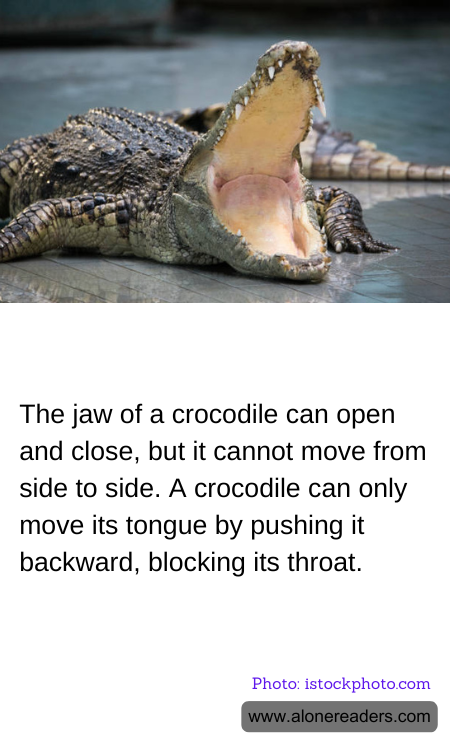
Crocodiles are fascinating creatures that have roamed the Earth for millions of years, and their unique anatomy has played a crucial role in their survival. One of the most intriguing aspects of a crocodile's anatomy is its jaw and tongue, which function in ways that are quite different from many other animals.
The jaw of a crocodile is a marvel of evolutionary engineering. It is designed primarily for strength and efficiency in capturing prey. Unlike mammals, whose jaws can move in multiple directions, a crocodile's jaw can only open and close. This limitation is offset by the incredible power with which it can snap shut, a feature that is essential for catching and holding onto prey. The muscles that close the jaw are exceptionally strong, allowing the crocodile to exert a tremendous amount of force. However, the muscles that open the jaw are relatively weak, which is why a human can hold a crocodile's mouth shut with their bare hands, provided they can avoid the initial snap.
Another interesting feature of the crocodile's anatomy is its tongue. Unlike many animals that can move their tongues freely, a crocodile's tongue is anchored to the bottom of its mouth by a membrane. This means that the tongue cannot move side to side or protrude from the mouth. The only significant movement the tongue can make is backward, which serves a critical function. When a crocodile pushes its tongue backward, it effectively blocks its throat. This adaptation is particularly useful when the crocodile is underwater, as it prevents water from entering the throat and lungs, allowing the crocodile to open its mouth without drowning.
This unique combination of jaw and tongue mechanics is perfectly suited to the crocodile's lifestyle. As ambush predators, crocodiles rely on stealth and power to capture their prey. Their ability to remain submerged with their mouths open, thanks to the tongue's blocking action, allows them to strike with surprising speed and force. Once they have captured their prey, the powerful closing action of their jaws ensures that escape is nearly impossible.
In summary, the crocodile's jaw and tongue are specialized adaptations that have enabled these ancient reptiles to thrive in their environments. The jaw's powerful closing mechanism and the tongue's ability to block the throat are both critical to the crocodile's hunting strategy and survival. These features highlight the incredible diversity of life on Earth and the myriad ways in which animals have evolved to meet the challenges of their habitats. Whether you're a budding biologist or simply a curious observer, the crocodile's anatomy offers a fascinating glimpse into the wonders of the natural world.
