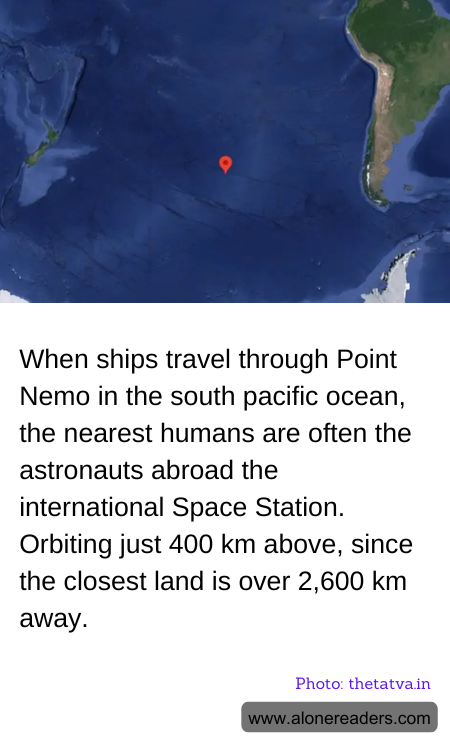
In the vast expanse of the South Pacific Ocean lies a point so remote that it is often closer to the astronauts aboard the International Space Station (ISS) than to any human on Earth. This point, known as Point Nemo, is the oceanic pole of inaccessibility, the farthest point from any landmass. It is a place where the nearest humans are not on the ground but orbiting the planet, a mere 400 kilometers above, while the closest land is over 2,600 kilometers away.
Point Nemo, named after Jules Verne's famous submarine captain, is a testament to the sheer scale and mystery of our planet's oceans. It is located at coordinates 48°52.6'S 123°23.6'W, a spot that is surrounded by thousands of kilometers of open water. This isolation makes it an ideal location for disposing of decommissioned spacecraft, as the likelihood of impacting human life or property is virtually nonexistent. Over the years, this remote part of the ocean has become a sort of spacecraft graveyard, where remnants of space missions find their final resting place.
The isolation of Point Nemo is not just a geographical curiosity but also a reminder of the vastness of our planet. In a world where technology has made communication and travel faster and more accessible than ever, Point Nemo stands as a stark contrast. It is a place where the silence is broken only by the sound of the ocean and where the nearest human presence is not on Earth but in the sky above. This unique characteristic makes it a fascinating subject for both scientists and adventurers alike.
For those aboard the ISS, the view of Earth from space offers a perspective that few will ever experience. As they orbit the planet, they pass over Point Nemo, looking down on the endless blue of the Pacific Ocean. From their vantage point, the isolation of this remote location is evident, a tiny dot in the vastness of the sea. It serves as a reminder of the delicate balance between exploration and preservation, as well as the importance of understanding and protecting our planet's oceans.
Point Nemo's remoteness also highlights the challenges faced by marine life in such isolated areas. While human activity is minimal, the impact of climate change and pollution knows no boundaries. The health of these remote waters is crucial to the overall well-being of the planet's oceans, and efforts to study and protect them are vital.
In conclusion, Point Nemo is more than just a geographical oddity; it is a symbol of the vastness and mystery of our world. It challenges our perceptions of distance and isolation and serves as a reminder of the interconnectedness of our planet. As ships pass through this remote point, they traverse a part of the world where the nearest humans are not on Earth but in space, highlighting the extraordinary nature of both our planet and the universe beyond.
