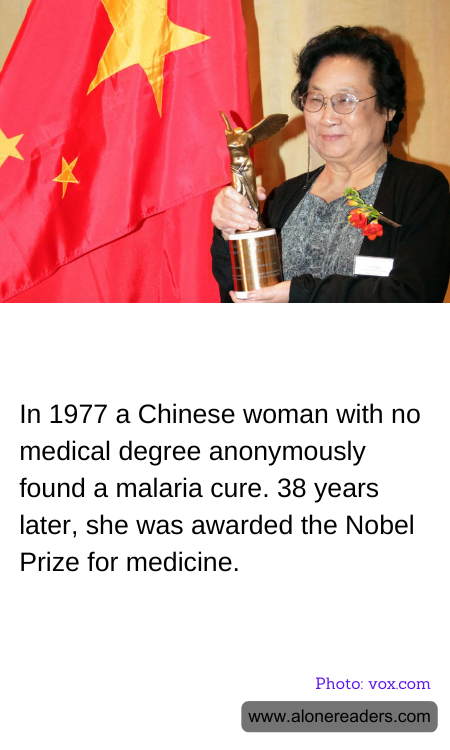
In 1977, a remarkable breakthrough in the fight against malaria emerged from an unexpected source. A Chinese woman named Tu Youyou, who had no formal medical degree, discovered a cure that would eventually save millions of lives. Her journey to this groundbreaking discovery is a testament to perseverance, ingenuity, and the power of traditional knowledge.
Tu Youyou was born in Ningbo, China, in 1930. She studied pharmacology at Beijing Medical University and later joined the China Academy of Traditional Chinese Medicine. During the 1960s and 1970s, malaria was a devastating disease, claiming countless lives worldwide. In response, the Chinese government launched a secret project known as Project 523, aiming to find a cure for malaria. Tu Youyou was appointed to lead a team of researchers tasked with this critical mission.
The team turned to ancient Chinese medical texts for inspiration, exploring traditional remedies that had been used for centuries. Tu Youyou's breakthrough came when she focused on sweet wormwood, a plant used in Chinese medicine for treating fevers. Through meticulous research and experimentation, she isolated a compound called artemisinin, which proved highly effective in reducing malaria parasites in the blood.
Despite the significance of her discovery, Tu Youyou's work remained largely unrecognized outside of China for many years. It wasn't until the late 20th century that the global medical community began to acknowledge the potential of artemisinin-based therapies. These treatments have since become the cornerstone of modern antimalarial strategies, drastically reducing mortality rates and offering hope to millions affected by the disease.
In 2015, Tu Youyou's contributions were finally recognized on the world stage when she was awarded the Nobel Prize in Physiology or Medicine. She became the first Chinese woman to receive a Nobel Prize in any scientific category. Her achievement was not only a personal triumph but also a celebration of the fusion of traditional knowledge and modern science.
Tu Youyou's story is an inspiring reminder that innovation can come from the most unexpected places. Her work underscores the importance of preserving and exploring traditional knowledge, as it can hold the key to solving some of the world's most pressing health challenges. Today, artemisinin-based combination therapies remain the most effective treatment for malaria, saving millions of lives each year.
Tu Youyou's legacy continues to inspire scientists and researchers around the globe. Her journey from an anonymous researcher to a Nobel laureate is a powerful testament to the impact of dedication, curiosity, and the relentless pursuit of knowledge. As the world continues to battle diseases old and new, her story serves as a beacon of hope and a reminder of the extraordinary potential within each of us to make a difference.
