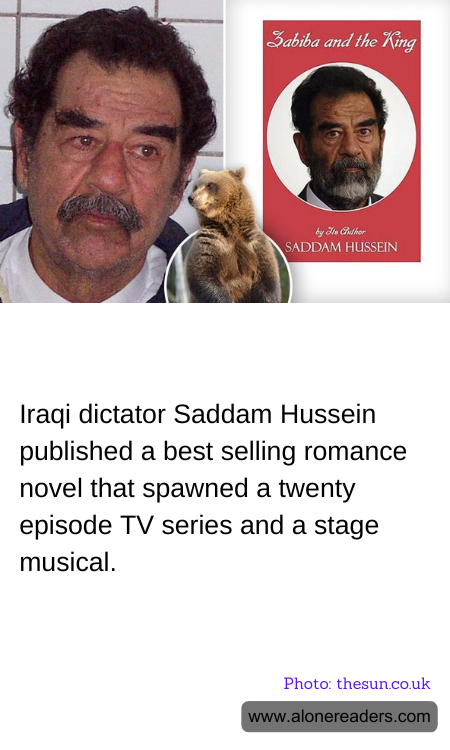
In the annals of literary history, few stories are as unexpected as that of Saddam Hussein, the former Iraqi dictator, who once turned his hand to romance writing. Known for his authoritarian rule and controversial political legacy, Hussein's foray into the world of fiction is a curious footnote that has intrigued historians and literary enthusiasts alike. His novel, "Zabibah and the King," published in 2000, surprisingly became a bestseller in Iraq and later inspired both a television series and a stage musical.
"Zabibah and the King" is set in a historical context and tells the story of a love affair between a king and a commoner named Zabibah. The narrative is laden with allegorical elements, reflecting themes of power, betrayal, and patriotism. Many interpret the novel as a political allegory, with the king symbolizing Saddam Hussein himself and Zabibah representing the Iraqi people. The story unfolds with Zabibah suffering at the hands of an abusive husband, which some analysts suggest mirrors Iraq's tumultuous relationship with foreign powers.
Despite its political undertones, the novel's romantic storyline captured the imagination of Iraqi readers, leading to its unexpected popularity. The book's success was further amplified by its adaptation into a twenty-episode television series, which aired on Iraqi state television. The series expanded on the novel's themes, bringing the characters to life and reaching a wider audience. The adaptation was a hit, drawing viewers with its dramatic plot twists and the allure of its forbidden romance.
The cultural impact of "Zabibah and the King" did not stop at the small screen. The story was also transformed into a stage musical, complete with elaborate sets and musical numbers that highlighted the emotional depth of the characters' relationships. The musical adaptation added a new dimension to the tale, blending traditional Iraqi music with theatrical storytelling, and was performed in several theaters across the country.
While the literary and artistic merits of "Zabibah and the King" are debated, its significance as a cultural phenomenon is undeniable. The novel and its adaptations offered a glimpse into the complex persona of Saddam Hussein, showcasing a side of the dictator that was rarely seen by the outside world. It also provided a unique lens through which to view the intersection of politics and art in Iraq during a turbulent period.
In retrospect, Saddam Hussein's venture into romance writing remains a peculiar chapter in the history of literature. It serves as a reminder of the power of storytelling to transcend even the most unlikely of origins, captivating audiences and leaving a lasting imprint on cultural memory.
